How Home Inspectors Get More Agent Referrals
Agent referrals are won on what happens after the inspection, not on drop-ins and donuts. What agents actually need, and why your report is the marketing.

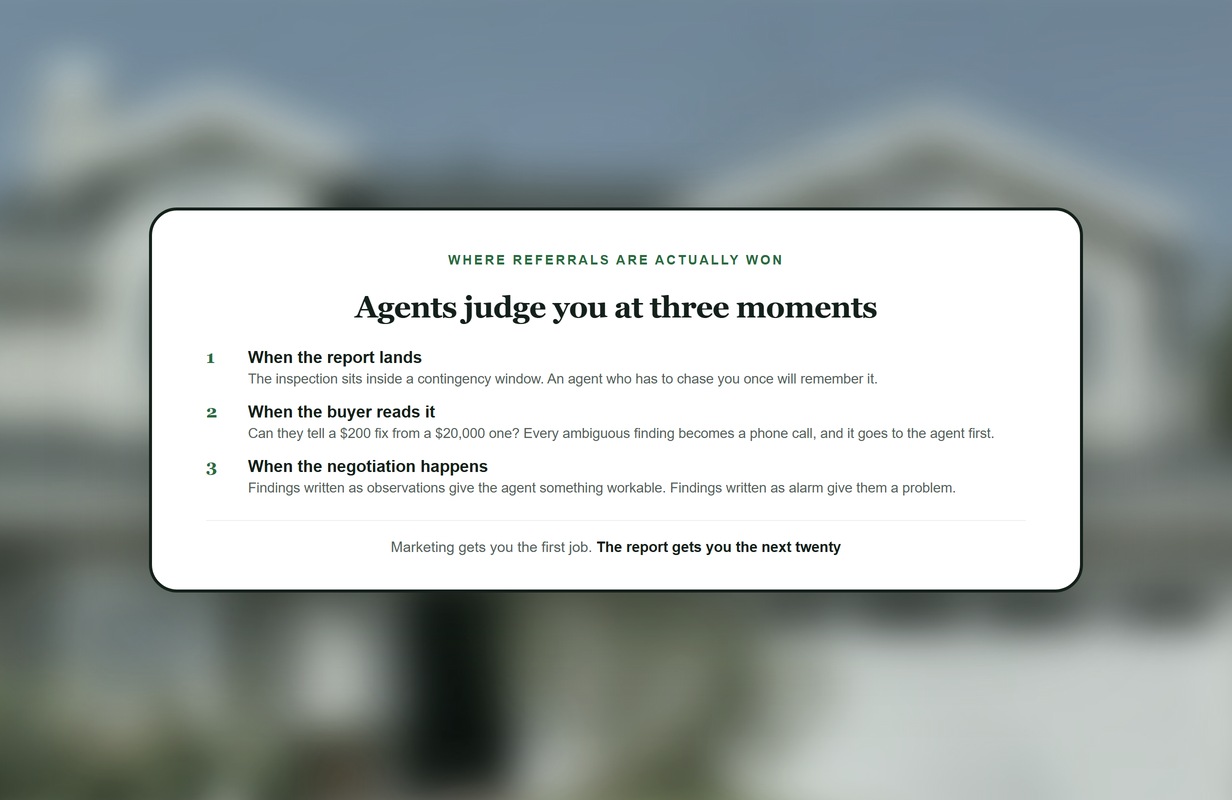
Short answer: Agents refer the inspector who makes their transaction easier, not the one who visits most often. That means a report the buyer understands without a phone call, delivered fast enough to fit the inspection contingency, written so it informs without detonating the deal. Marketing gets you the first job. The report gets you the next twenty.
Most advice about agent referrals is about getting in front of agents. Office presentations, drop-ins, branded pens, lunch. Some of it works a little. None of it explains why the inspector who does none of it has more referral business than the inspector who does all of it.
What an agent is actually solving for
An agent has a deal with a contingency period and a nervous buyer. Your inspection is the moment that deal is most likely to fall apart, and not usually because of what you found.
Deals die from confusion. A buyer reads a report they do not understand, cannot tell a $200 fix from a $20,000 one, panics at the volume of findings, and walks. Every agent has watched this happen and remembers which inspector it happened with.
So the agent is not looking for the most thorough inspector, or the cheapest, or the friendliest. They are looking for the one whose reports produce informed buyers instead of frightened ones, on a timeline that fits the contingency.
That is the whole game. Almost everything else is noise.
Why the report is your marketing
An agent sees your work product three times: when it lands, when the buyer calls them about it, and when the repair negotiation happens. Those three moments do more for your referral pipeline than any amount of face time.
When it lands. Is it same day, or does it arrive the evening before the contingency expires? An agent who has to chase you once will remember. Turnaround is the single most controllable variable you have, and it is why report speed is a sales issue rather than a comfort one.
When the buyer reads it. Does the summary let them separate safety from maintenance? Do the photographs show the actual defect, annotated, or is it a picture of a wall with a comment underneath? Every ambiguous photo becomes a phone call, and the call usually goes to the agent first.
When the negotiation happens. Findings written as observations with clear implications give the agent something to work with. Findings written as alarm give them a problem to manage.
Write to inform, not to alarm or to hide
This is the line that inspectors get wrong in both directions, and the one agents are quietly judging.
Underplaying a defect to keep a deal alive is not just unethical, it is the fastest way to a claim. No referral is worth that, and any agent who wants it from you will drop you the moment it goes wrong.
But there is a real difference between reporting a finding accurately and reporting it dramatically. "Evidence of prior moisture intrusion at the northwest corner of the basement slab. No active moisture at time of inspection. Recommend monitoring and evaluation by a qualified contractor if recurrence is observed" tells everyone exactly what you saw. It does not tell the buyer their house is rotting.
Structure helps more than wording. State the finding, state why it matters, state what to do about it. Every comment. A client who understands the shape of the problem does not need to call anyone to interpret it.
Give the agent their own way in
Most inspectors service the agent relationship by email. The report goes to the buyer, a copy goes to the agent, and then everything after that is texts and forwarded PDFs.
That is fine until an agent is running six transactions and cannot find your report from three weeks ago. A dedicated agent view, where they can see reports, agreements, scheduling and payment status without going through you, removes a category of friction that neither of you enjoys.
Binsr includes agent dashboards for exactly this reason. The point is not the feature; it is that a referral partner who can self-serve is a referral partner who does not have to weigh whether contacting you is worth the trouble.
Make booking take thirty seconds
An agent recommending you is doing it in a moment: on the phone, in a car, between showings. If the next step is "call this number during business hours", you have introduced a delay in which the buyer will google other inspectors.
Online booking with real availability, agreements that go out automatically and payment collected up front means the agent can hand over a link and be finished. Binsr includes booking, scheduling, agreements and Stripe payments for this reason: the referral is won or lost in the sixty seconds after the agent recommends you. It also means you are not choosing between answering the phone and doing the inspection you are currently inside.
The relationship work that does matter
Face time is not worthless. It is just the smallest lever, and it works differently than most inspectors think.
Be reachable on the day it matters. An agent with a question during a contingency period needs an answer that day. Being the inspector who picks up is worth more than any presentation.
Educate rather than pitch. Agents genuinely do not know what is in your scope, what your standards of practice require, or why you will not say whether a roof has five years left. A fifteen-minute explanation of what an inspection is and is not makes you the expert they call. A brochure makes you a vendor.
Never make them look bad. If you find something significant, the agent should not learn about it from their client. A heads-up call takes two minutes and buys years of goodwill.
Ask, once. Inspectors are strangely reluctant to say "if this was useful, I would appreciate you keeping me in mind." Say it once, after a job that went well. Do not say it every time.
What to stop doing
Office drop-ins with food, unless you already have a relationship there. You are interrupting people who are working and the food gets eaten by whoever is nearest the kitchen.
Discounting to win agent business. An agent who selects on your price is selecting for their buyer's budget, not for quality, and they will move the moment someone undercuts you. You cannot build a referral base on being cheapest.
Anything that looks like paying for referrals. Rules on inducements vary by state and the consequences are disproportionate to the benefit. If you are unsure whether a gift or a sponsorship crosses a line, ask your association or your attorney before you do it, not after.
How to know if it is working
Track where every booking came from. Not roughly, exactly. Ask on the booking form, or ask on the phone, and record it.
Within six months you will know which agents actually refer, which ones referred once, and which relationships you have been maintaining for no return. Most inspectors are surprised by how concentrated it is: a small number of agents produce most of the referral volume, and they are not always the ones you spend the most time with.
Then put your effort where the referrals actually are, and let the report do the rest.
Frequently asked questions
Keep reading
More in streamlining your inspection business, why usability is a risk control and Binsr features.
Try Binsr on five real inspections. No time limit, no credit card. See pricing or start your trial.