How to Build a Home Inspection Comment Library
Your comment library is the most valuable thing you own. How to structure one, write defect language that survives a dispute, and what to write first.

Short answer: Build it in the order you actually inspect, write every comment as finding, implication and recommendation, and keep the number of options per item small enough to choose from without scrolling. Five good comments per item beats forty, because a library you cannot navigate is slower than typing.
Your comment library is the most valuable thing you own inside your software. It is years of wording that survived client questions, agent pushback and the occasional contractor telling your buyer you were wrong. It is also the single reason inspectors stay on platforms they no longer like.
Most advice on building one is about volume. That is the wrong target.
Why more comments make you slower
The instinct is to write a comment for every possible condition, so the right one always exists. What actually happens is that you end up scrolling forty near-identical options at the kitchen sink, reading each one to find the one you meant, and taking longer than typing it fresh.
A library earns its keep by removing decisions, not by covering every case. If you have to read three comments to pick one, you have not saved anything.
The practical ceiling is around five primary options per item. Five covers the conditions you genuinely encounter, stays visible without scrolling, and is small enough that you know what is in it. Everything rarer is a comment you write on the day, which is fine, because it is rare.
That is a hard rule to follow when building, because every comment feels necessary while you are writing it. Cut anyway.
Structure it the way you inspect
The library should mirror your walk through the property, not a taxonomy of building systems.
If you inspect exterior first, the library starts with exterior. If your roof section comes before your attic because that is the order you climb, build it that way. Any mismatch between how you move and how the software is arranged is a small tax you pay on every single job.
Two structural decisions save a lot of time later.
Consolidate sections that behave the same. Separate entries for Bedroom 1, Bedroom 2, Bedroom 3 and Bedroom 4 mean four places to look for the same comment. One Living Spaces section covering bedrooms, hallways and living areas is faster to navigate and no less thorough, because the findings are identical anyway.
Keep genuinely different rooms separate. Bathrooms and kitchens have their own systems, their own failure modes and their own client expectations. Folding them into a general section costs clarity for no gain.
Write every comment the same way
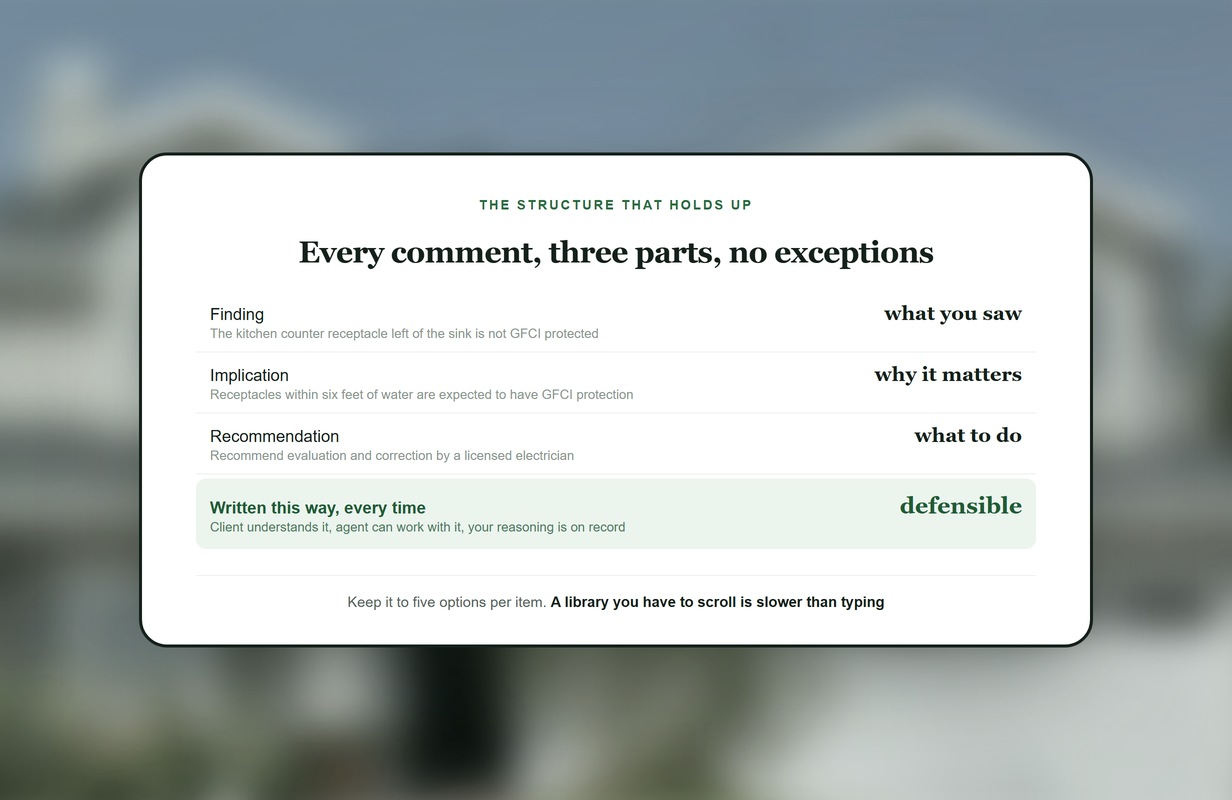
The structure that holds up is finding, implication, recommendation. Every comment, no exceptions.
Finding. What you observed, specifically and neutrally. "The kitchen counter receptacle to the left of the sink is not GFCI protected."
Implication. Why it matters, in terms a buyer understands. "Receptacles within six feet of a water source are required to have GFCI protection to reduce shock hazard."
Recommendation. What to do, and who does it. "Recommend evaluation and correction by a licensed electrician."
This structure does three things at once. The client understands the issue without calling anyone. The agent has something workable in a repair negotiation. And you have documented an observation, a reason and an action, which is what protects you if the finding is ever disputed.
Language that survives a challenge
The wording choices that matter are not stylistic.
Report what you saw, not what you concluded. "Evidence of prior moisture intrusion" is defensible. "The basement leaks" is a conclusion you cannot support from a single visit and did not observe.
Reference standards, not code. Phrases like "current standards", "manufacturer requirements" and "generally accepted building practice" hold up. Citing a specific code section invites a contractor to arrive with the code book, find that the section did not apply at the time of construction, and tell your client you were wrong. You are usually not a code official, and your standards of practice probably say so.
State your limitations in the comment, not just the boilerplate. If you could not access something, say so where the finding is, not only in a limitations page nobody reads. "Attic inspected from the access hatch only; insulation depth prevented safe traverse" belongs next to the attic findings.
Avoid remaining-life estimates. "The roof has about five years left" is a prediction, not an observation, and it is the kind of sentence that comes back.
Write for the buyer, not for another inspector. The audience is a nervous person who has never bought a house before. Jargon they have to look up becomes a phone call to their agent.
Build it in the right order
Do not start at the beginning and work through. Start where the volume is.
First, the twenty findings you write on almost every job. Missing GFCI protection, negative grading, worn roof covering, missing handrails, water heater strapping, dryer venting, aged HVAC. Get these right and you have covered most of your writing on most inspections.
Then the recurring findings specific to your area. Every market has them. Post-tension slabs, polybutylene, aluminium branch wiring, cast iron drains, particular local building eras. These are where a generic library serves you worst and where your own knowledge is most valuable.
Then limitations and exclusions. An underrated section. Well-written limitation narratives inform the client about what an inspection is and is not, without sounding defensive. They also prevent the "why didn't you tell me about X" conversation.
Then everything else, as you meet it. Write the comment on the day you first need it, immediately, while the context is fresh. That is how a library grows properly.
Do not start from an empty system
Building a full library from scratch takes hundreds of hours, and you will spend the first year discovering that a third of your comments are worded badly.
Starting from a professional library and editing it into your voice is faster and produces better wording, because you are reacting to language rather than generating it. Reacting is easier and more accurate.
Binsr ships more than 12,000 comments and templates written by two inspectors with over 60 years of combined field experience, including the KC Bartley Inspection Template, its Texas TREC version, and official forms like the NPMA-33 and the Florida insurance set. They are all editable. Most inspectors use them as a base and reshape them over the first few months.
If you already have a library you like, keep it. Any platform worth using should import it rather than making you rebuild, and that is a question worth asking before you switch anything.
Maintain it, or it decays
A library is not a project you finish.
Edit at the point of friction. When you find yourself rewording the same comment for the third time, stop and fix the source. That instinct to "just change it this once" is how libraries rot.
Review the ones that generate calls. If a client or agent asks about the same finding repeatedly, the comment is unclear. That is free feedback and most inspectors ignore it.
Prune. Once a year, look for comments you have not used. Delete them. The library gets faster.
Keep an independent export. Whatever platform you are on. Software gets acquired, retired and repriced. Your language is the asset, and it should never live in only one place.
Frequently asked questions
Keep reading
More in free home inspection templates, cutting report time and Binsr features.
Try Binsr on five real inspections. No time limit, no credit card. See pricing or start your trial.