How to Write Inspection Comments That Hold Up
The wording choices that decide whether a finding is defensible: observation over conclusion, standards over code, and why remaining-life estimates come back.

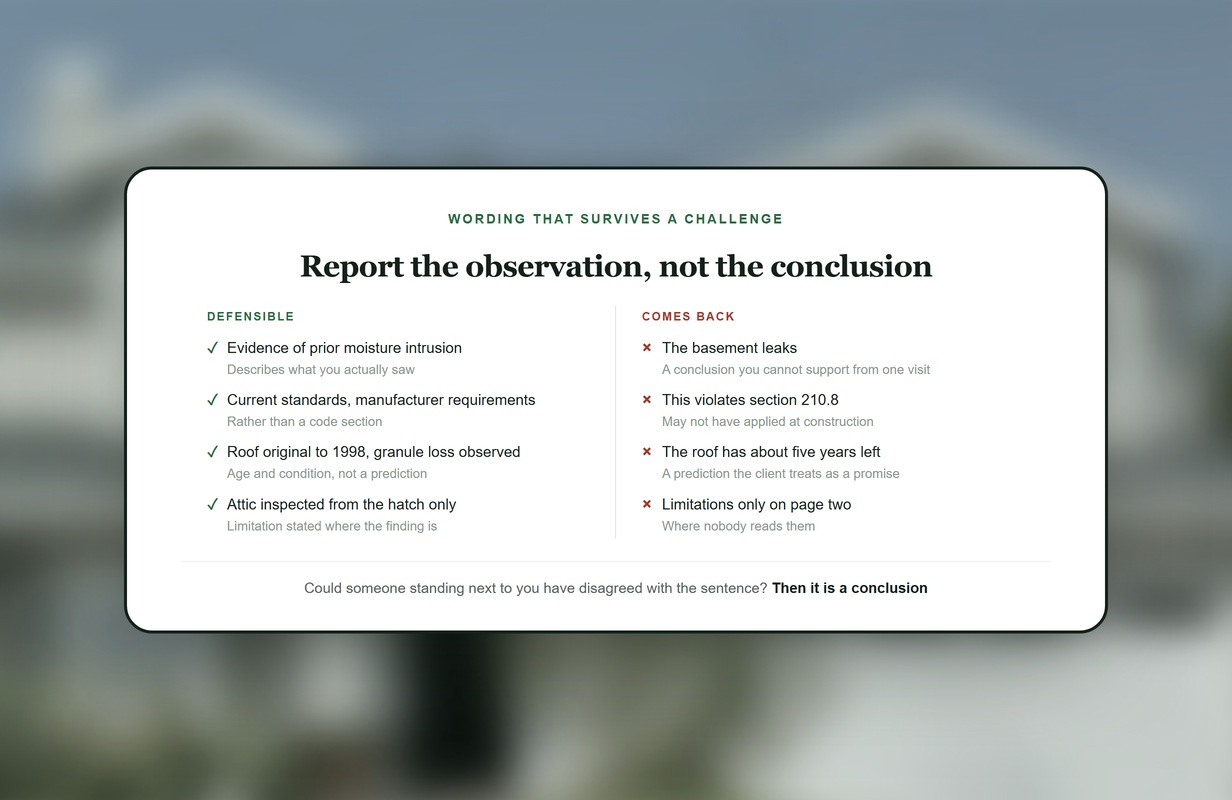
Short answer: Report the observation, not the conclusion. Reference standards and manufacturer requirements rather than code sections. State limitations next to the finding rather than in a page nobody reads. Never estimate remaining life. And write every comment as finding, implication and recommendation, so the client understands it at the time rather than after something fails.
Most complaints against inspectors are not about missed defects. They are about findings that were reported in language the client did not absorb, or worded in a way the inspector could not support later.
That makes comment wording a liability control, not a style preference.
This is not legal advice. Standards of practice and licensing rules vary by state. Check yours, and talk to your E&O carrier about wording if you are unsure.
Report what you saw, not what you concluded
This is the single most important distinction, and it is easy to get wrong under time pressure.
"The basement leaks" is a conclusion. You did not observe leaking; you observed evidence consistent with past water entry, during one visit, in whatever weather that day held. If a contractor later demonstrates the basement is dry, you own the claim.
"Evidence of prior moisture intrusion at the northwest corner of the slab. No active moisture at the time of inspection." is an observation. It is defensible because it is true, and it tells the client more, not less.
The test: could someone standing next to you have disagreed with the sentence? If yes, you have written a conclusion.
Reference standards, not code
Citing a specific code section feels authoritative and creates two problems.
The first is that the code in force when the house was built may differ from the current one, so a contractor arrives with the book, finds the section did not apply, and tells your client you were wrong about something you were substantially right about.
The second is scope. Most standards of practice do not position inspectors as code officials, and claiming code authority you do not have is its own exposure.
Safer phrasing: "current standards", "manufacturer requirements", "generally accepted building practice". These describe why the condition matters without inviting a technical argument about which edition applied in 1987.
Write every comment the same way
Finding, implication, recommendation. Every one, no exceptions.
Finding: "The kitchen counter receptacle to the left of the sink is not GFCI protected."
Implication: "Receptacles within six feet of a water source are expected to have GFCI protection to reduce shock hazard."
Recommendation: "Recommend evaluation and correction by a licensed electrician."
Three things happen at once. The client understands the issue without phoning anyone. The agent has something workable in a repair negotiation. And you have documented an observation, a reason and an action, which is exactly the sequence anyone reviewing a complaint wants to see.
Comments missing the implication are the ones clients skip. Comments missing the recommendation are the ones that generate calls.
Put limitations where the finding is
Every report has a limitations page. Almost no client reads it.
If you could not fully inspect something, say so next to that section: "Attic inspected from the access hatch only; insulation depth prevented safe traverse." That sentence, in place, does more protective work than three paragraphs of general boilerplate, because it is read at the moment it is relevant.
The same applies to conditions on the day. Weather, occupancy, stored belongings, utilities shut off. If it limited what you could assess, it belongs in the report next to what it limited.
Never estimate remaining life
"The roof has about five years left." "The water heater should last another two or three years."
These are predictions, not observations, and they are among the most common sources of complaints. You cannot know, the client will treat it as a commitment, and when the roof fails in eighteen months they will remember the number.
Report age and observed condition instead. "Roof covering appears to be original to the 1998 construction. Granule loss and curling observed at the south slope. Recommend evaluation by a qualified roofing contractor." The client gets more useful information and you have promised nothing.
Make severity unmistakable
If everything in a report looks equally serious, nothing registers, and the client cannot tell a $200 fix from a $20,000 one.
Use your severity categories deliberately and consistently. A safety hazard should look different from a maintenance item at a glance. The most common complaint pattern is a client saying "it was in there but I had no idea it was important", and that is a categorisation failure rather than a reporting one.
Consistency across a report matters as much as the categories themselves. A summary that reads more or less severe than the body is a contradiction, and contradictions are what get picked apart.
Write for the buyer
The reader is usually a nervous person who has never bought a house. Jargon they have to look up becomes a phone call to their agent, and the agent remembers.
That does not mean dumbing anything down. It means defining the term the first time, explaining why it matters, and avoiding shorthand that only means something to another inspector.
Where AI helps and where it does not
AI drafting is genuinely useful here, with one specific caution.
It helps with consistency. Standing guidance on tone, structure and how cautious your language should be, applied across every report, removes the drift that happens when you are writing the fortieth comment at 9pm. In Binsr that is AI Instructions, alongside Combine Comments with AI for merging several observations about one issue into a single coherent comment.
The caution is that generated language tends toward the declarative. It will write "the flashing is improperly installed" where the honest version is "flashing appears improperly installed at the visible portion; remainder concealed by roofing". That difference is the whole case in some disputes.
So when you review, look specifically for statements more confident than your observation supports, and for missing limitations. Both matter more if a finding is ever disputed. Those are the two places generated comments fail, and they are both quick to spot once you know to look.
Frequently asked questions
Keep reading
More in building a comment library, what happens when a client complains and Binsr features.
Try Binsr on five real inspections. No time limit, no credit card. See pricing or start your trial.