How to Deliver Same-Day Home Inspection Reports
Same-day delivery is a workflow change, not a speed contest. What has to move to the property, what to cut, and how to do it without thinning the report.

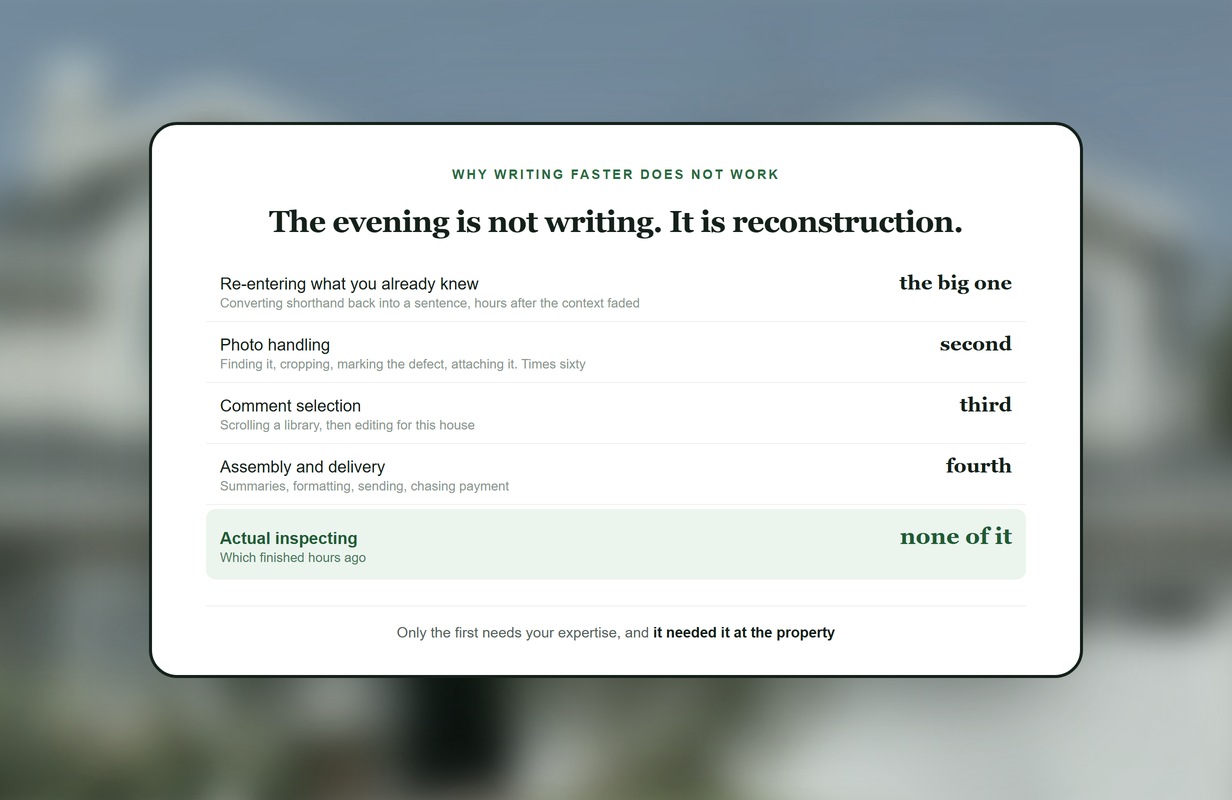
Short answer: Same-day delivery is not about writing faster. It is about moving the writing to the property, so what is left afterwards is review rather than composition. Inspectors who achieve it reliably capture findings as report content on site, use a tight comment library, and have removed the administrative steps that sit between finishing and sending.
The inspection sits inside a contingency period, which is why turnaround has quietly become an expectation rather than a selling point. Agents remember the inspector they had to chase.
Here is what actually has to change.
Why "write faster" does not work
The instinct is to compress the evening: better focus, fewer distractions, a faster typing setup. It produces small gains and burns people out.
The reason is that the evening is not mostly writing. It is reconstruction. You are converting shorthand you wrote hours ago back into complete thoughts, and the context you had at the property has partly decayed. That reconstruction is the expensive part, and it is not something you can do quickly by trying harder.
Same-day delivery comes from eliminating the reconstruction, not accelerating it.
Move the composition to the property
The single change that matters. Capture findings in a form that is already report content, at the moment you observe them.
The practical version is speaking the complete thought rather than a reminder. "GFCI kitchen" is a reminder that costs you two minutes tonight. "Kitchen counter receptacle left of the sink, no GFCI protection, within six feet of the basin, recommend a licensed electrician install GFCI protection" is the comment, finished.
It feels verbose out loud. It is the difference between sending at 4pm and sending at 9pm.
This is what Binsr's AI Voice and Photo Quick Add are built for: turning what you say and photograph into structured report content in the right section, rather than a transcript you tidy up later. The Report Builder works offline, which matters because the crawlspace that generates the most content usually has the least signal.
Handle photographs once
Photographs are the second-largest sink, and most inspectors touch them three times: taking them, finding them again, then annotating and attaching them.
Do it once. Photograph the defect, annotate it, attach it to the finding, move on. A photo filed in the moment costs seconds. The same photo filed in the evening costs a minute of working out which bathroom it was.
Annotation is not cosmetic here either. An unannotated photograph of a wall generates a client phone call, and that call arrives tomorrow, which is time you did not budget.
Tighten the comment library
A library with forty near-identical options per item is slower than typing. You end up reading three comments to choose one.
Five primary options per item is the practical ceiling. It covers what you genuinely encounter, stays visible without scrolling, and is small enough that you know what is in it. Anything rarer you write on the day.
If you are starting from scratch, do not. Binsr ships more than 12,000 comments and templates written by two inspectors with over 60 years of combined field experience, and if you already have a library you trust, the importer brings it across rather than making you rebuild.
Remove the steps between finishing and sending
This is where same-day quietly dies. The report is written by 3pm and goes out at 8pm because of everything in between.
Summary generation. Should be configuration, not composition. If you are writing the summary from scratch after finishing the body, that is a second pass over the same material.
Delivery. Should be one action. Digital report and PDF, to client and agent, in a single step.
Invoicing. Send it with the report rather than later in the week. It gets paid faster and it is one fewer task in your evening.
Review. Keep this one. It is the only step in the list worth its time, and the whole point of recovering the hours is being able to read the report properly before it goes.
What same-day should not cost you
Speed is only worth having if the report is at least as good. A fast, vague report is worse than a slow, clear one, and clients cannot tell the difference until something goes wrong.
Two things to protect.
Specificity. The report should contain observations that could only come from that property. Generic language is what makes a client ask whether anyone actually looked at the house.
Your review pass. Read every word before it goes out, particularly if AI drafted any of it. Generated language drifts toward the confident, and a statement more certain than your observation supports is exactly the sentence that comes back.
Set the expectation deliberately
If you can do same-day reliably, say so. It is a real differentiator with agents, who are managing a contingency clock.
If you cannot do it every time, do not promise it. Promising and missing is worse than a stated 24-hour turnaround met consistently. Agents plan around reliability, not around your best case.
And price it. If same-day is part of what you sell, it belongs in the fee rather than being given away as a courtesy.
How to know it is working
Track one number: minutes from leaving the property to the client having the report.
Not writing time, which hides the searching and the photo sorting. Door to delivery. Take a baseline over five inspections, change one thing, measure five more.
Most inspectors are surprised by where their time actually goes. Some lose it to photographs, some to comment selection, some to the administrative gap at the end. Fixing the wrong one feels productive and changes nothing.
Frequently asked questions
Keep reading
More in cutting report time with AI tools, building a comment library and Binsr features.
Try Binsr on five real inspections. No time limit, no credit card. See pricing or start your trial.