What Real Estate Agents Want From an Inspection Report
Agents judge inspectors on three moments: when the report lands, when the buyer reads it, and when the negotiation happens. What each one actually requires.

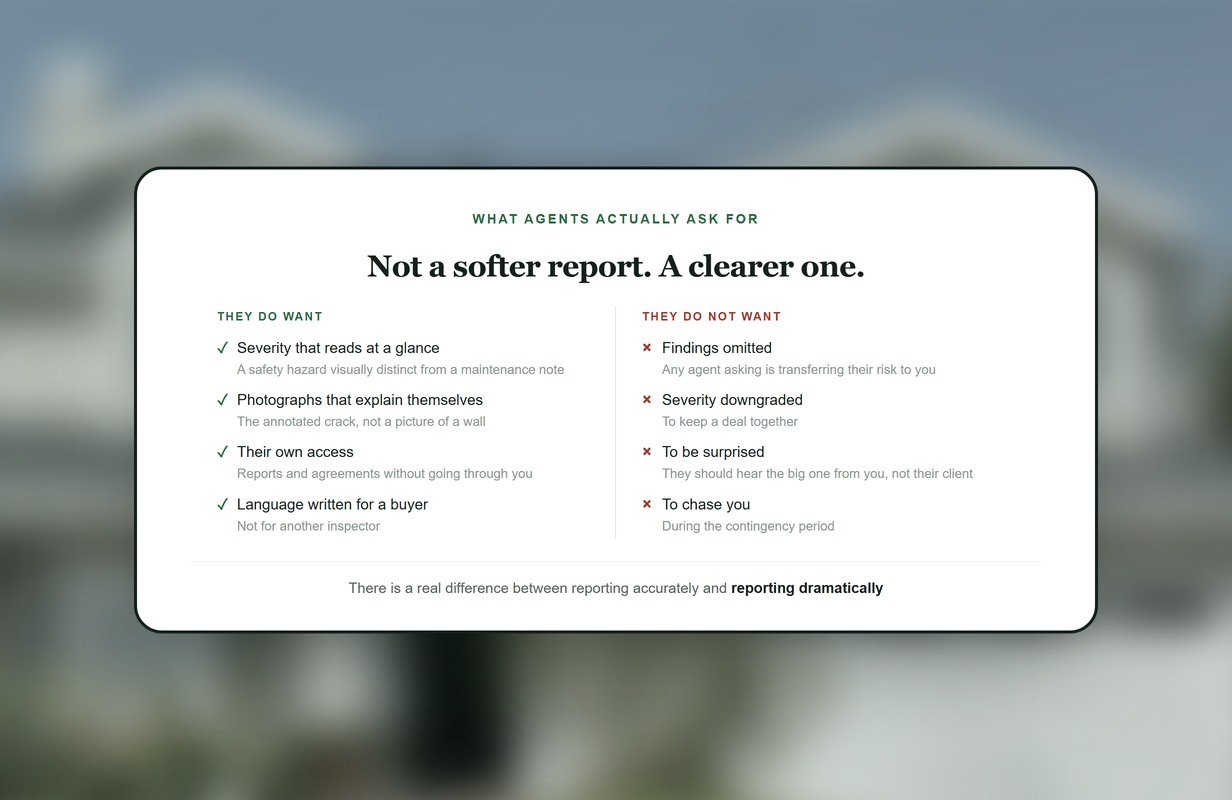
Short answer: Speed that fits the contingency period, a summary that separates safety from maintenance, photographs the buyer can interpret without calling anyone, and findings written as observations rather than alarm. Agents are not asking you to soften anything. They are asking you to be clear enough that nobody panics at something routine.
The most common misunderstanding about agents is that they want a lighter report. Most do not, and the ones who do should not be your referral base.
What they want is a report that produces an informed buyer instead of a frightened one, on a timeline that fits their deadline.
The three moments you are judged on
When it lands. The inspection sits inside a contingency window. Same-day is increasingly treated as normal, and an agent who has to chase you once will remember it. This is the most controllable variable you have.
When the buyer reads it. Can they tell a $200 fix from a $20,000 one? Do the photographs show the actual problem, or a wall? Every ambiguous finding becomes a phone call, and the call goes to the agent first.
When the negotiation happens. Findings written as observations with clear implications give the agent something workable. Findings written as alarm give them a problem to manage.
Everything else, including how pleasant you are and how often you visit their office, is smaller than these three.
What "clear" actually means here
Severity that reads at a glance. If every finding looks equally serious, none of them registers. A safety hazard should be visually distinct from a maintenance note before anyone reads a word. The most common complaint pattern is a buyer saying "it was in there but I had no idea it mattered", and that is a categorisation failure.
A summary that helps someone prioritise. Not a list of everything again, shorter. A summary should answer "what do I actually need to deal with?" Configurable summaries and a downloadable summary PDF matter here, because the buyer and the agent are reading for different reasons.
Photographs that explain themselves. An annotated image showing the specific crack does the work. An unannotated photo of a wall creates a question. This is the single highest-leverage improvement most inspectors can make to how their reports are received.
Language written for a buyer. Jargon they have to look up becomes a call to the agent. Define the term, say why it matters, avoid shorthand that only means something to another inspector.
What agents are not asking for
Worth being direct, because this is where inspectors get pressured.
They are not asking you to omit findings. They are not asking you to downgrade severity to keep a deal together. Any agent who does is asking you to carry their risk, and they will not be there when the claim arrives.
There is a genuine difference between reporting accurately and reporting dramatically, and that difference is where the skill sits. "Evidence of prior moisture intrusion at the northwest corner of the slab. No active moisture at time of inspection. Recommend monitoring and evaluation by a qualified contractor if recurrence is observed" tells everyone exactly what you found. It does not tell the buyer their house is rotting.
Same information. Different outcome.
Give the agent their own access
Most inspectors service this relationship by email: report to the buyer, copy to the agent, then texts and forwarded PDFs for the next three weeks.
That works until an agent is running six transactions and cannot find your report from a fortnight ago. A dedicated agent view, where they can see reports, agreements, scheduling and payment status without going through you, removes a category of friction neither of you enjoys. Binsr includes agent dashboards for this reason.
The point is not the feature. It is that a referral partner who can self-serve does not have to decide whether contacting you is worth the trouble.
The small things that lose referrals
Chasing. If they have to ask where the report is, you have already cost yourself something.
Surprises. If you find something significant, the agent should hear it from you, not from their client. A two-minute call before you send buys years of goodwill.
Being unreachable during the contingency. A question during that window needs an answer that day. Being the inspector who picks up is worth more than any presentation you could give.
Inconsistency. If two reports from your firm read differently, agents notice. This matters more once you have a second inspector, and it is why shared comment libraries and standing guidance on tone are worth setting up before you hire.
Ask them
The most underused tactic in this whole subject.
Send your last report to two agents who refer you regularly and ask what they would change. Not "was it good", which gets you a polite yes. Ask specifically: was anything confusing, did your buyer call you about something the report should have answered, is the summary useful.
The answers are usually small, concrete and immediately actionable, and almost nobody asks. It also signals that you take the relationship seriously, which is worth more than the feedback.
Frequently asked questions
Keep reading
More in how inspectors get more agent referrals, delivering same-day reports and Binsr features.
Try Binsr on five real inspections. No time limit, no credit card. See pricing or start your trial.