How Much Should a Home Inspector Charge?
Most inspectors price by copying the competition. Here is how to set a fee from your own costs, capacity and risk, and when to charge more than the going rate.

Short answer: Price from your own numbers, not the market's. Work out your true cost per inspection, decide how many inspections you can deliver well in a year, add the profit you actually need, and check the result against local rates only to see whether you have a positioning problem. Copying the going rate is how inspectors end up busy and broke.
Ask what to charge in any inspector forum and you get a range, a regional caveat and an argument. That is because the question has no market answer. It has your answer, and it comes from arithmetic almost nobody does.
Why "what's the going rate" is the wrong question
The going rate tells you what your competitors decided, usually by looking at what their competitors decided. Follow it and you inherit someone else's cost structure, someone else's insurance premium and someone else's tolerance for working weekends.
It also assumes you are selling the same thing. You are not. An inspector delivering a same-day report with annotated photos, an agent portal and a phone call to walk the buyer through it is not selling what the cheapest inspector in the county is selling, and should not be priced against them.
The rate matters, but as a sense check at the end. Not as a starting point.
Start with what an inspection actually costs you
Most inspectors dramatically underestimate this because they only count what leaves their bank account on inspection day.
Direct costs per job. Fuel and vehicle wear. Payment processing, which is a real percentage of every fee and varies more than inspectors expect. Any report delivery or software cost that scales per inspection. Consumables.
Processing is worth checking specifically, because it applies to every dollar you collect. Rates in this category run from about 2.9% to 3.35% plus a per-transaction fee, and half a percentage point across 250 inspections is real money. Binsr passes card processing through at cost, 2.9% + $0.30, with ACH at 0.8%.
Annual costs divided by inspections. This is where it gets uncomfortable. Errors and omissions insurance. General liability. Software subscriptions. Association dues. Continuing education. Vehicle payment and maintenance. Phone. Accounting. Marketing and website. Equipment replacement, because the thermal camera and the moisture meter do not last forever.
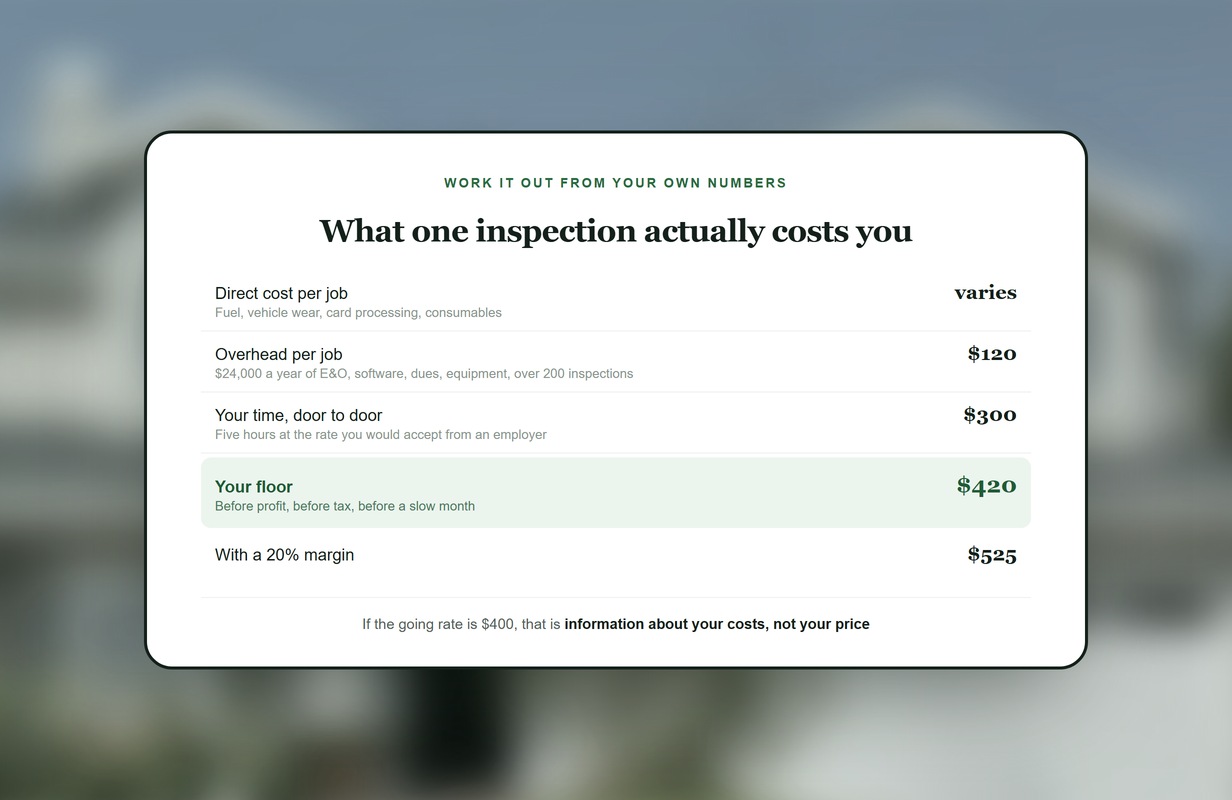
Add the annual figure up, divide by the number of inspections you will realistically do, and you have your overhead per job. For a solo inspector doing 200 inspections against $24,000 of annual costs, that is $120 per inspection before you have paid yourself a cent.
Your time, at a rate you would accept from an employer. Not just the three hours on site. Count the drive, the scheduling call, the report writing, the follow-up questions, the invoice chasing. If a job consumes five hours door to door and you want the equivalent of $60 an hour, that is $300.
Now you have a floor. In that example, $120 plus $300 is $420 before profit, before tax, before a single slow month.
| What goes in | The worked example | Your number |
|---|---|---|
| Direct cost per job | Fuel, vehicle wear, card processing, consumables | |
| Overhead per job | $24,000 of annual costs across 200 inspections | $120 |
| Your time, door to door | 5 hours at the $60 an hour you would accept from an employer | $300 |
| Your floor | Before profit, before tax, before a slow month | $420 |
| With a 20% margin | What you actually charge | $525 |
Fill the right-hand column in with your own figures. If the number you get is above the going rate in your market, that is information about your costs, not a reason to charge less.
Then work out what you can actually deliver
This is the number that gets ignored, and it is the one that decides whether the business works.
Capacity is not how many inspections you could physically attend. It is how many you can attend and report on well, without the reports stacking up. If your process leaves two hours of writing per job, your ceiling is much lower than your calendar suggests.
Work out your honest annual capacity, subtract holidays, illness, slow season and the weeks where nothing books, and divide your income target by what is left. Inspectors routinely build a plan on 300 inspections and deliver 210.
This is also why report speed is a pricing issue and not just a comfort one. Every hour you remove from the reporting process is capacity you can either sell or keep. Two hours saved per inspection across 200 inspections is 400 hours, which is roughly ten more working weeks in your year.
It is the reason we built Binsr around capturing findings during the inspection rather than after it. Capacity is the constraint that decides what you can charge, and reporting time is the largest single input to it.
Add the profit you need, not the profit you hope for
Profit is not what is left over. It is a line item you decide in advance.
Decide what the business needs to generate beyond your own wage: equipment replacement, a buffer for a bad quarter, growth, retirement. Add it as a percentage on top of the floor, not as a hope that volume will produce it.
If your floor is $420 and you want a 20% margin, your fee is $525. If the local going rate is $400, you now know something specific and useful: either your costs are too high, your capacity is too low, or you are trying to compete on price in a market where you cannot win. All three are fixable. None of them is fixed by charging $400 and working harder.
What legitimately changes the number
Square footage and age. Larger and older homes take longer and carry more risk. Most inspectors tier by square footage, with a base fee covering a range and increments above it. Age matters as much as size; a 1920s house at 1,800 square feet can take longer than a new build at 3,000.
Crawlspaces, outbuildings, additional units. Anything that adds inspection surface should add fee.
Distance. A travel band beyond a radius, set so a distant job is not quietly your least profitable one.
Risk. This is the one inspectors underprice most consistently. A property type or a client situation that raises your exposure should raise your fee, because it raises your real cost even when nothing goes wrong.
Turnaround. If you offer same-day delivery as standard, that is part of what you are selling and it belongs in the price rather than being given away.
Ancillary services need their own arithmetic
Radon, mold, sewer scopes, thermal imaging, pool and spa, wind mitigation. Each has equipment, training, sometimes lab costs, and its own liability profile.
Price each one on its own numbers rather than as a bolt-on discount to the main inspection. The question for each is simple: how many of these do I need to sell per year for the equipment, training and added risk to pay for themselves, and is that number realistic in my market? If it is not, that service is a hobby.
The bundling instinct is strong and usually wrong. A discounted bundle that moves a client from one service to three is only good business if all three are individually profitable.
The real reason most inspectors do not charge enough
It is not that the arithmetic is hard. It is that raising your price means believing you are worth it, and that is a different kind of problem.
Ask experienced inspectors why they held their fee too long and you get some version of the same answer: it felt presumptuous. Not "the numbers said no", but a quiet worry that a client would ask what makes them worth $150 more than the inspector down the road, and that they would not have a good answer.
The way through is not confidence. It is having the answer ready, and the answer is what you have actually built. Better tools than you had three years ago. Ancillary services you are genuinely good at, so you can connect findings across a septic system and a house rather than reporting them as two unrelated jobs. Faster turnaround. A report that does not generate phone calls. Time to research a property before you arrive, which you only have if you are not running three inspections a day.
That last point cuts both ways, and it is worth sitting with. If you are working seven days a week at three inspections a day, you do not have time to add value. The volume is what is preventing the thing that would justify the price. Charging more and doing fewer is not just better income; it is often the only route to being better at the job.
There is also a capacity trade that inspectors rarely run properly.
| Three a day at $300 | Two a day at $450 | |
|---|---|---|
| Daily revenue | $900 | $900 |
| Reports to write | 3 | 2 |
| Drives | 3 | 2 |
| Time per client | Lower | Higher |
| Callback exposure | Higher | Lower |
Same money, one fewer report, hours back. The instinct says you cannot afford to lose the third job. The arithmetic frequently says the opposite.
When to raise your prices
The signals are clearer than most inspectors admit.
You are booked out further than clients will wait. You are turning work away. You have not raised prices in two years while insurance and fuel have. You are the cheapest inspector you know and you are not winning on volume.
Raise on new bookings only, give existing agent relationships a heads-up rather than a surprise, and do it in a defensible increment rather than an apologetic one. The most common outcome is that almost nobody mentions it. The second most common is that you lose the clients who were only ever going to choose on price, which is the point.
If you are nervous, raise on a subset first, watch the booking rate for a month, then apply it across the board.
The number to actually watch
Not your fee. Your profit per inspection after everything, and your capacity utilization.
A $600 inspection that takes eight hours door to door is worse business than a $450 inspection that takes four. Inspectors who track only the headline fee end up optimizing for the wrong thing, taking the big complicated jobs and wondering why the year was hard.
Track fee, total time door to door, and cost per job. Do it for twenty inspections. The pattern usually surprises people, and it will tell you more about what to charge than any regional survey.
Frequently asked questions
Keep reading
More on the operations side in streamlining your inspection business, cutting report time and Binsr pricing.
Try Binsr on five real inspections. No time limit, no credit card. See pricing or start your trial.