How to Raise Your Inspection Prices Without Losing Clients
When to raise your home inspection fees, how much, how to tell your agents, and what actually happens afterwards. The realistic version, not the pep talk.

Short answer: Raise on new bookings only, tell your regular agents before an invoice does, and move in one defensible step rather than a series of apologetic ones. Most clients say nothing. The ones who leave were choosing on price and would have left anyway. The bigger risk is waiting another year.
Almost every inspector who raises their prices reports the same two things afterwards: it went better than expected, and they wish they had done it sooner.
Almost every inspector who has not raised prices has the same reason, and it is not the numbers.
The signals that you are overdue
You are booked further out than clients will wait. If people are calling and going elsewhere because you cannot fit them in, you are converting demand into someone else's revenue.
You are turning work away. Same thing, more obvious.
Your costs have risen and your fee has not. Insurance, fuel, software, equipment. If your fee is the same as two years ago, you have taken a real pay cut and simply not noticed it happening.
You are the cheapest inspector you know, and it is not producing volume. Being lowest priced only works if it wins you materially more work. If it does not, you have accepted the downside of a discount strategy without the upside.
Every job feels rushed. If you cannot research a property before arriving or review a report properly before sending it, your fee is not buying you enough time to do the job the way you want to.
The trade nobody runs properly
Inspectors resist raising prices because they are afraid of losing volume. Very few actually do the arithmetic on what that loss costs.
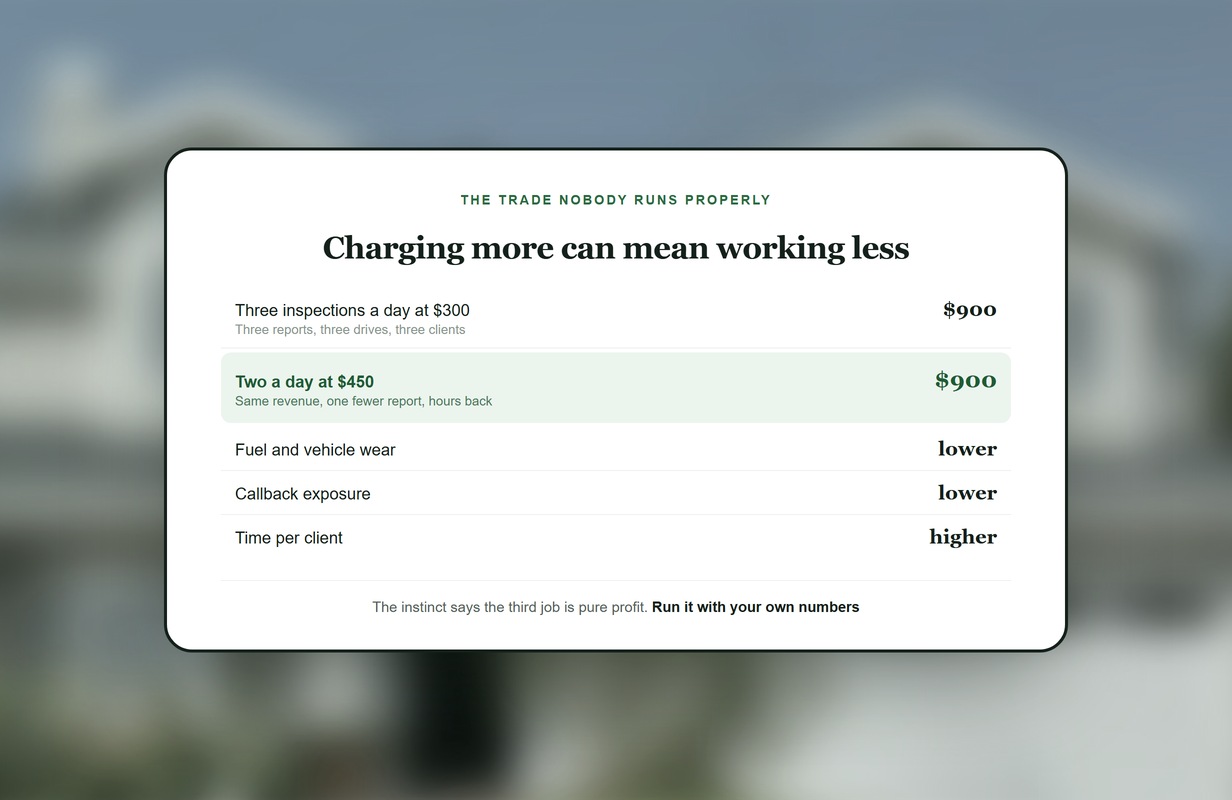
Say you are doing three inspections a day at $300.
| Three a day at $300 | Two a day at $450 | |
|---|---|---|
| Daily revenue | $900 | $900 |
| Reports to write | 3 | 2 |
| Drives | 3 | 2 |
| Clients to manage | 3 | 2 |
| Hours back | None | Several |
Same revenue, one fewer report to write, one fewer drive, one fewer client to manage, and several hours back.
Now factor in that each inspection carries cost and risk. Fewer jobs at a higher fee means less fuel, less wear, fewer chances of a callback, and more time per client. The higher-priced day is a better day on every measure, and revenue did not move.
Run this with your own numbers before you decide you cannot afford to lose a job. The instinct says the third inspection is pure profit. It rarely is.
The part that is not arithmetic
Most inspectors who have held their prices too long will admit, if pushed, that the barrier was not the spreadsheet. It was a quiet worry that a client would ask what makes them worth more, and that they would not have a good answer.
That is worth naming, because you cannot fix it with a calculator.
The answer is not confidence. It is having something specific to point at, and building it if you do not. Better equipment than you had three years ago. Ancillary services you are genuinely good at, so you can connect a septic finding to a plumbing finding rather than reporting them as two unrelated jobs. Same-day delivery. A report that does not generate phone calls. Time to research a property before you arrive.
Most of that list is downstream of how long your reports take. It is why Binsr is built to finish more of the report on site: the hours you recover are what pay for the equipment, the training and the extra service that justify the next increase.
There is a trap in that last one. If you are running three inspections a day, seven days a week, you do not have time to develop any of it. The volume is preventing the very thing that would justify the price. Charging more and doing fewer is often the only route to becoming the inspector who deserves the higher fee.
How much
One meaningful increase beats three timid ones. Repeated small rises make you look unstable to agents and make you have the awkward conversation three times.
Work out your floor first: direct costs, annual overhead divided by realistic inspections, and your time at a rate you would accept from an employer. Add the margin the business actually needs. That is your number.
If the gap between your current fee and that number is large, it is reasonable to close it in two steps over a year rather than one. But do not close a $150 gap in $25 increments.
Who to tell, and when
New bookings only. Anything already booked goes at the quoted price, no exceptions. Honouring a quote costs you a little and protects your reputation entirely.
Tell your regular agents first. Not a mass email. A short note or a call to the handful who actually refer you: the fee is going to X from a date, here is why in one sentence, everything already booked is unaffected.
They will almost never argue. What they will not forgive is finding out from a client's invoice, because it makes them look uninformed in front of their buyer. That is the actual risk in a price rise, and it is entirely avoidable.
Give a lead time. Two to four weeks. It lets agents with pending deals plan, and it converts anyone who was going to book anyway.
Say it once, plainly. Do not over-explain, do not apologise, do not itemise your cost increases. "Our fee is going to $X from the first of the month" is the whole message. Justification invites negotiation.
Handling the pushback
Most of it does not arrive. What does arrive falls into three types.
The price shopper. Asks your fee first and nothing else. You will lose some of these and that is the intended outcome. They were never going to refer you, and they are the most likely to be difficult afterwards.
The agent whose buyer is stretched. Genuine and worth handling well. You are not obliged to discount, but you can offer scheduling flexibility, or explain what the fee covers. Some will proceed. Some will not, and will still refer you next time.
The regular who is surprised. This one is a communication failure, not a pricing one. It is why you tell them first.
What not to do is quietly hold the old price for anyone who pushes. Word travels between agents, and a fee that bends under pressure is not a fee.
What to watch afterwards
Not your booking rate on its own. That will wobble for a few weeks regardless and tell you nothing.
Watch revenue per week and inspections per week together, over a couple of months. The pattern you want is inspections flat or slightly down, revenue up. If inspections fall sharply and revenue drops with them, you have a positioning problem the price rise exposed rather than caused, and the answer is what you deliver rather than what you charge.
Also watch what you do with the recovered time. If a higher fee and fewer jobs simply becomes more hours doing nothing in particular, the increase has not bought you anything. Spend it on the things that justify the next one.
One more number worth checking while you are here: payment processing applies to every dollar you collect, and rates vary. Binsr passes card fees through at cost, 2.9% + $0.30, with ACH at 0.8%. Over a few hundred jobs a year that gap can be larger than the price rise you are nervous about.
Frequently asked questions
Keep reading
More in how much a home inspector should charge, getting agent referrals and streamlining your business.
Try Binsr on five real inspections. No time limit, no credit card. See pricing or start your trial.