Does an AI-Written Inspection Report Hold Up in a Dispute?
What happens when an AI-assisted inspection report is challenged. Where liability sits, what documentation matters, and the failure modes to guard against.

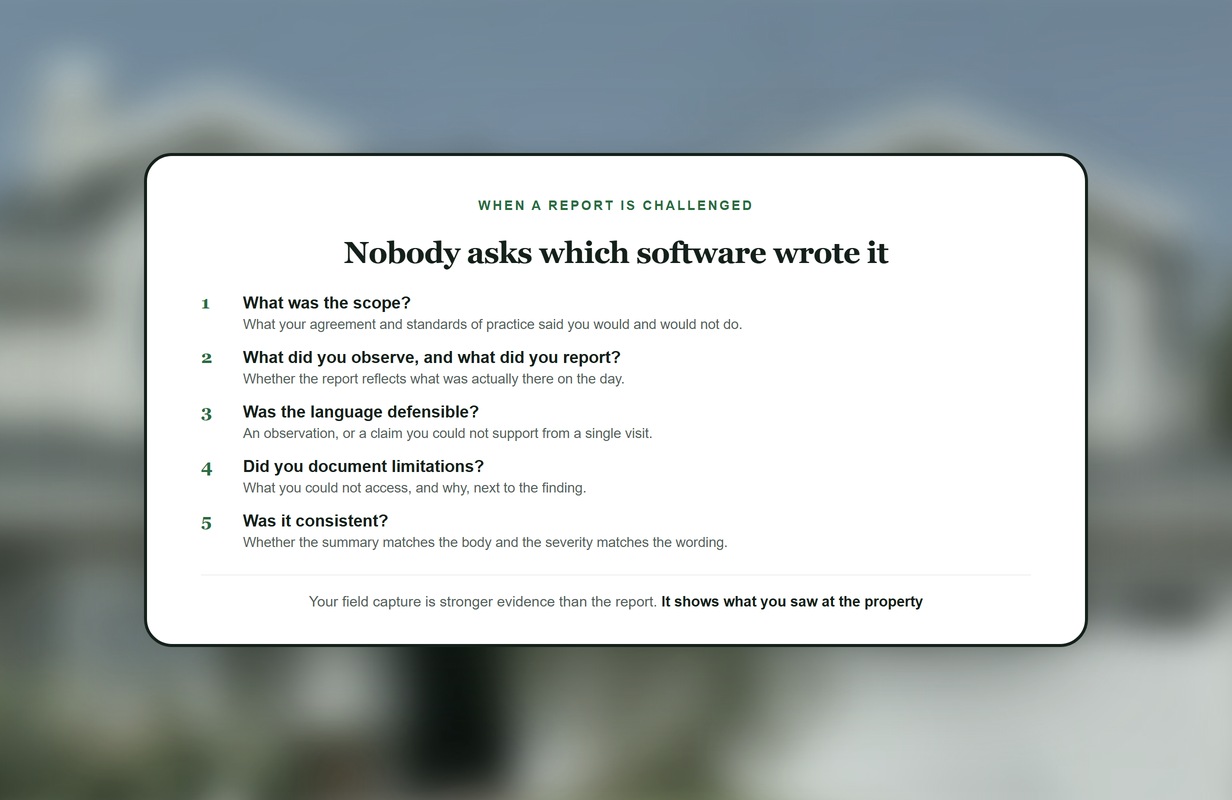
Short answer: The report holds up or fails on exactly the same terms as one you typed yourself, because you are the author either way. No adjuster or attorney is going to ask which software produced the sentence. They will ask what you observed, what you wrote, and whether the two match. AI changes how fast the report is produced, not who answers for it.
This is not legal advice. Standards of practice, licensing rules and case law vary by state, and none of this substitutes for your own attorney or E&O carrier. It is a practical look at where the risk actually sits.
The question behind the question
Inspectors asking this are usually worried about one of two things.
The first is that using AI is itself a mark against them, that a claim will go worse because a model was involved. It is closely related to whether you have to disclose AI use at all. There is no basis for that. Your report is your professional statement, produced with whatever tools you chose, exactly as it has been since inspectors started using comment libraries and templates.
The second worry is the real one: that AI will put something in a report you did not observe, you will not catch it, and you will have to defend a sentence you never actually wrote. That is a legitimate concern, it is specific, and it is manageable.
What actually gets examined
When an inspection report is challenged, the questions are consistent and none of them are about software.
What was the scope? What your agreement and standards of practice said you would and would not do.
What did you observe, and what did you report? Whether the report reflects what was actually there on the day.
Was the language defensible? Whether you reported an observation or made a claim you could not support from a single visit.
Did you document limitations? Whether you noted what you could not access and why.
Was it consistent? Whether your summary matches your body, and whether the severity you assigned matches the language you used.
An AI-assisted report answers all five in the same way a manually written one does. The difference is that a generated report can fail some of them in ways a manual one usually does not.
Three failure modes worth guarding against
Fabricated specificity. This is the one that matters. Given thin input, these systems fill gaps with plausible detail. A comment that mentions a component you never saw, a location you did not inspect, or a condition you did not observe is a serious problem in a legal document, and the fact that software generated it is not a defence.
The mitigation is input. A model given "GFCI kitchen" has to invent almost everything. A model given the location, the condition, what you checked and your recommendation has nothing left to make up. The less you say, the more it invents.
Overconfident language. Manual writing hedges naturally, because you know where your observation ended and your inference began. Generated language tends toward the declarative. It will write "the flashing is improperly installed" where you would have written "flashing appears improperly installed at the visible portion; remainder concealed by roofing."
That difference is the whole case, in some disputes. When you review, look specifically for statements more certain than what you actually saw supports.
Systematic error. A manual mistake is a single mistake. A wrong standing instruction, or a habit of accepting a generated phrasing without reading it, replicates across every report until someone notices. The error is not worse, but the exposure is multiplied.
What actually protects you
Read every word. Every report, every time, before it goes out. Reviewing a generated report is faster than writing one, which is the entire benefit, but it is not optional and it is not skimming. If you would not defend a sentence in a deposition, delete it.
Keep your field capture. Voice notes, timestamped photographs, the original observations. This is stronger evidence than the report itself, because it shows what you observed at the property before any software touched it. If a comment is challenged, the capture is what demonstrates the finding was real.
This is a genuine advantage of capture-first workflows and it is rarely mentioned. An inspector who spoke their findings on site has a contemporaneous record. An inspector who wrote from memory at 9pm does not.
It is one of the reasons Binsr captures by voice and photo during the inspection rather than after it. The speed is the visible benefit. The contemporaneous record is the one you only appreciate if a finding is ever challenged.
Keep photographs attached to findings, annotated. A marked-up image showing the defect you described is the most direct evidence there is that you observed what you reported.
Never delegate the judgment. Whether something is a defect, how serious it is, whether it needs a specialist. Those are yours. A model has no standard of care, carries no licence, and cannot be a defendant. Use it for the writing between your judgment and the client's understanding of it.
Keep your limitations specific and local. Note what you could not access where the finding is, not only in a general limitations page. "Attic inspected from the hatch only; insulation depth prevented safe traverse" next to the attic section does more work than a paragraph on page two.
Where AI can actually help your position
Worth saying, because the framing is usually one-sided.
Consistency. A significant share of disputes come from a report contradicting itself: a summary that reads more or less severe than the body, or the same condition described differently in two places. Standing instructions and comment combining reduce that; in Binsr those are AI Instructions and Combine Comments with AI.
Completeness. Generated content is less likely to trail off. Manual writing at the end of a long day produces the thin comments, and thin comments are the ones that get challenged.
Clarity. A lot of claims begin with a client who did not understand what they were told. Language written for a buyer rather than for another inspector prevents the confusion that becomes a complaint.
Speed, which buys review time. If drafting takes twenty minutes instead of two hours, you have time to actually read it properly. Most inspectors use that time to go home, which is fair, but the option is there.
The rule that covers all of it
You are the author. Every sentence in the report is one you adopted by publishing it under your name and licence.
That was true when you used a comment library someone else wrote. It was true when you reused your own boilerplate for the four hundredth time. It is true now. The tool changed; the standard did not.
If you would not put your name to it, do not publish it. That single test resolves nearly every version of this question.
Frequently asked questions
Keep reading
More in whether you have to disclose AI use, the AI glossary for home inspectors and the Binsr report builder.
Try Binsr on five real inspections. No time limit, no credit card. See pricing or start your trial.