What Happens When a Client Complains About an Inspection?
How inspection complaints actually unfold, what boards and carriers look at, and what to do in the first 48 hours. Most are resolvable if handled early.

Short answer: Most complaints never become claims. They become claims when an inspector goes quiet, gets defensive, or cannot produce documentation from the day. Respond quickly, listen properly, do not admit or deny liability in writing, notify your carrier early rather than late, and let your field record do the work.
Every inspector gets one eventually. What decides how it goes is almost never the finding itself. It is the first 48 hours.
This is not legal advice. Licensing rules, complaint procedures and carrier obligations vary by state and by policy. Contact your E&O carrier and, where warranted, an attorney.
What a complaint usually actually is
Most begin the same way: something went wrong after closing, the client is upset, and they are looking for an explanation.
Frequently it is something the report did mention, in language the client did not absorb, buried among forty other findings. Sometimes it is genuinely outside the scope of a visual inspection. Occasionally it is a real miss, because inspectors are human and buildings hide things.
The critical point is that at this stage it is a person with a problem, not a legal action. How you behave now decides which it becomes.
The first 48 hours
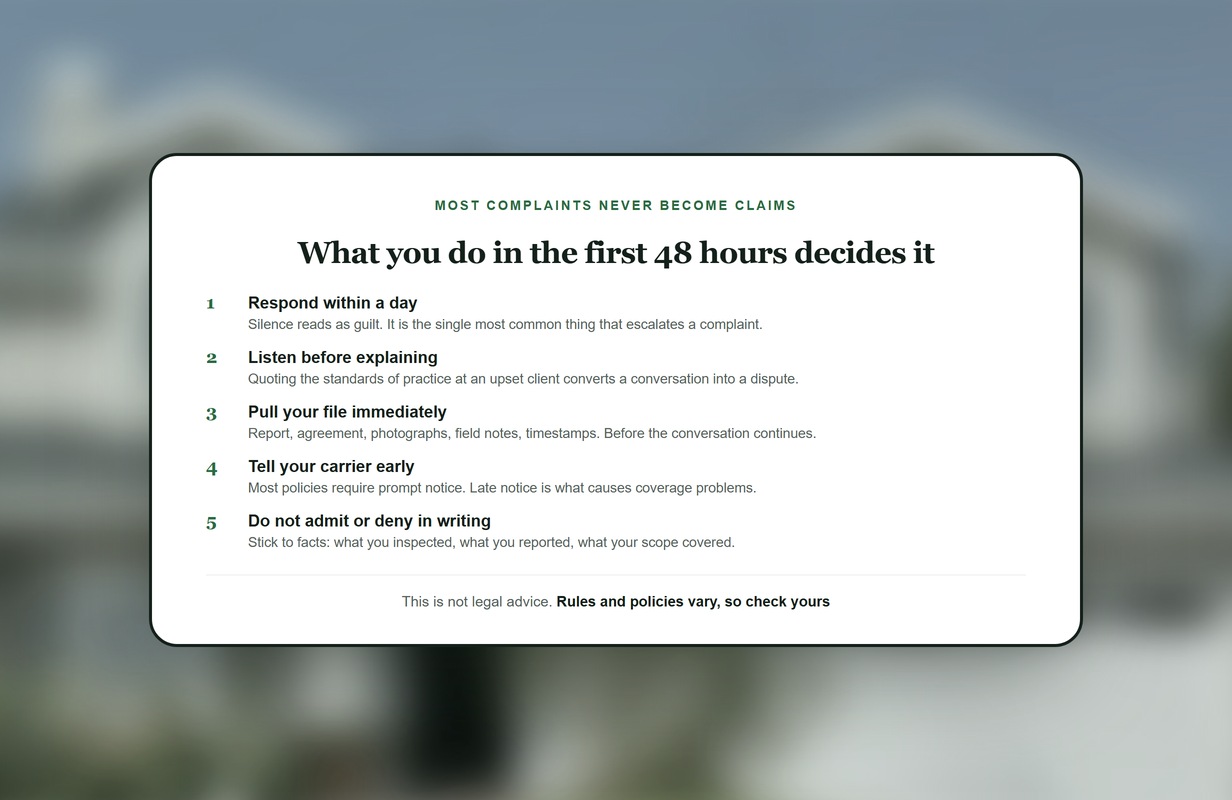
Respond quickly. Within a day. Silence reads as guilt or indifference, and it is the single most common thing that escalates a complaint. Even "I've received this, I'm looking into it, I'll come back to you by Thursday" resets the temperature.
Listen before explaining. Most people want to be heard more than they want money. An inspector who immediately quotes the standards of practice at an upset client has converted a conversation into a dispute. Ask what happened, when they noticed, what they were told by whoever found it.
Do not admit or deny liability in writing. Not because you are hiding something, but because your policy almost certainly requires it and an early written concession can complicate coverage. Stick to facts: what you inspected, what you reported, what your scope covered.
Pull your file immediately. The report, the agreement, the photographs, your field notes, the timestamps. Do this before the conversation continues, not after, because your memory of a job from six weeks ago is worse than you think.
Tell your carrier early. Inspectors delay this hoping it resolves itself, and delay is exactly what causes coverage problems. Most policies require prompt notice. A call that turns out to be unnecessary costs nothing; late notice can cost the policy.
What actually gets examined
Whether it goes to a licensing board, a carrier or an attorney, the questions are consistent.
What did the agreement say? Scope, limitations, exclusions, any liability provisions. This is the first document anyone reads.
What did the report say? Whether the condition was mentioned, how clearly, and whether the language matched the severity.
Was it within scope? A visual inspection of accessible areas is not a warranty and not a technically exhaustive examination. A great many complaints resolve here.
Was access limited, and did you say so? If you could not enter the crawlspace, the report needs to say that, next to the crawlspace section rather than buried in a general limitations page.
What documentation exists from the day? Photographs, notes, timestamps. This is where cases are won or lost, and it is the part inspectors control most directly.
Why documentation from the day matters more than the report
The report is your conclusion. Your field record is the evidence for it.
Timestamped, annotated photographs showing what you observed, and notes captured at the property rather than reconstructed at 9pm, are far stronger than a recollection. They demonstrate that you looked, what you saw, and what the conditions were.
This is one of the underrated arguments for capturing findings on site rather than writing from memory later. Binsr records voice and photo capture during the inspection, which produces a contemporaneous record as a by-product of the workflow. The speed is the visible benefit. The record is the one that matters on the day someone questions a finding.
Comment language decides a lot of these
A significant share of complaints trace back to how a finding was worded rather than whether it was found.
Writing every comment as finding, implication and recommendation does three things. The client understands the issue at the time rather than after something fails. The severity is unambiguous. And you have documented an observation, a reason and an action, which is exactly what an adjuster or a board wants to see.
Two wording habits cause disproportionate trouble. Stating a conclusion you could not support from one visit, such as "the basement leaks" rather than "evidence of prior moisture intrusion". And estimating remaining life, such as "the roof has about five years left", which is a prediction rather than an observation and comes back.
When to offer something, and when not to
If you got something wrong, saying so plainly and early usually costs less than defending it. Inspectors are often more forgiven for a genuine miss handled well than for a defensible position argued badly.
But do not offer money, refunds or repairs without speaking to your carrier first. A well-meant payment can be treated as an admission and can affect coverage on a larger claim later. Talk to them before you offer anything, even if the amount seems trivial.
If the complaint is outside scope and you are confident of that, say so respectfully, with reference to the agreement, and without triumph. Being right is not the same as being effective.
Reducing how often this happens
Explain limitations at the inspection, in person. Clients absorb spoken caveats far better than written ones. Ten seconds at the crawlspace hatch prevents a conversation months later.
Make severity unmistakable. If everything looks equally alarming, nothing registers, which is a comment library problem as much as a reporting one. Clear categories let a client know what to worry about.
Photograph everything you report, annotated. An image showing the exact condition is worth more than a paragraph describing it, both for comprehension and for evidence.
Follow up after delivery. A short message asking whether they have questions catches misunderstandings while they are still cheap.
Never soften a finding to protect a deal. No referral relationship is worth a claim, and any agent who wants that from you will not be there when it goes wrong.
Frequently asked questions
Keep reading
More in building a comment library that survives a dispute, whether an AI-written report holds up and Binsr features.
Try Binsr on five real inspections. No time limit, no credit card. See pricing or start your trial.