When Should You Hire a Second Home Inspector?
The volume, cash flow and capacity signals that mean it is time to hire, what breaks first, and why most inspectors hire too late rather than too early.

Short answer: When you are consistently turning work away, you have three to six months of runway to carry a second inspector before they are productive, and you have raised your prices first. Hiring to escape being overworked at a low fee just multiplies a bad unit economic. Fix the price, then fix the capacity.
Most inspectors get this decision wrong in one of two directions. They hire far too late, having spent two years exhausted and turning away work. Or they hire to solve a problem that was actually a pricing problem, and end up with two people underearning instead of one.
Raise your prices before you hire
This is the step people skip, and it is the one that decides whether the hire works.
If you are booked solid, that is the market telling you your fee is below what it will bear. Hiring at that point locks in the low fee and adds a salary to it. Now you need twice the volume to reach the same profit, which means the pressure that made you hire has not gone away, it has doubled.
Raise first. See where demand settles. Some inspectors discover the capacity problem disappears at the new price, because the marginal work they were straining to fit in was work they did not want. Others find demand holds and they now have margin to pay someone properly.
Either outcome is more useful than hiring into a fee you already suspect is too low.
The signals that you are genuinely at capacity
You are turning work away consistently. Not in one busy fortnight. Over a quarter, in a normal season.
Your lead time exceeds what clients will wait. If you are booking three weeks out in a market where the contingency period is ten days, you are losing work you never hear about.
Reports are stacking up. This is the one to look at hardest, because it might not be a capacity problem at all. If you can attend four inspections a day but only write two reports, your constraint is the reporting workflow, not the number of people. Fixing that is much cheaper than a salary.
You are declining ancillary work. Turning down a radon test on a job you are already attending is leaving money on the table for no reason other than time.
Something is slipping. Late reports, missed calls, an unhappy agent. The business is already past capacity and you are absorbing it personally.
Check the cheaper fixes first
A second inspector is the most expensive answer to "I have too much work". Before it, three things cost far less.
Reporting time. If you spend two hours per report, across 200 inspections that is 400 hours, which is roughly ten working weeks. Capture-first workflows are aimed exactly here: Binsr turns voice and photo capture into report content during the inspection, so less waits for you afterwards. Recovering an hour a job may add more capacity than a part-time hire.
Administrative load. Booking calls, agreement chasing, invoicing, scheduling. If a meaningful slice of your week is admin, online booking with automatic agreements and payment collection recovers it without a payroll.
A non-inspecting assistant. Considerably cheaper than an inspector, no licensing required, and they can absorb scheduling, client communication and invoicing. On Binsr non-inspecting staff are free, since billing is per inspector, so the software cost of this route is zero.
Work through those before you conclude you need another inspector. Frequently you do not.
What hiring actually costs
Underestimating this is why hires fail.
They are not productive immediately. Depending on their experience and your standards, expect one to three months of shadowing and supervised work before they inspect alone, and longer before their reports need no editing. During that time you are paying them and inspecting yourself.
Your own output drops. Training is not free time. Expect to lose real capacity while you supervise, which is the opposite of what you hired for.
Liability extends to their work. Their reports go out under your business name. Your E&O exposure grows and your premium probably will too. Talk to your carrier before you hire, not after.
Fixed cost against variable revenue. A salary does not care about your slow season. This is the difference between a solo business and a firm, and it is the part that keeps people awake.
Have three to six months of their cost available before you start. If that number frightens you, you are not ready, and that is useful information rather than a failure.
What breaks first
Report consistency. Two inspectors, two writing styles, two interpretations of severity. Clients and agents notice. This is why a shared comment library matters more in a multi-inspector firm than a solo one, and why standing guidance on tone and structure is worth setting up before the second person starts, not after.
Scheduling. Two calendars, two service areas, two skill sets. What you held in your head no longer fits there.
Quality control. You cannot review every report forever, but you cannot stop reviewing early either. Most firms settle on reviewing everything for the first few months, then sampling.
The client relationship. Agents referred you. Some will be unhappy to get someone else, and they need telling before it happens rather than discovering it on the day.
Employee or contractor
Get this right at the start. Classification rules vary by state and misclassification is expensive to unwind.
The general shape: if you control how, when and where they work, provide the equipment and the templates, and they work only for you, that looks like employment in most jurisdictions. Genuine contractors set their own methods and typically work for several businesses.
Ask an accountant or employment attorney about your specific situation before you write an offer. This is not a corner worth cutting to save a consultation fee.
The order that works
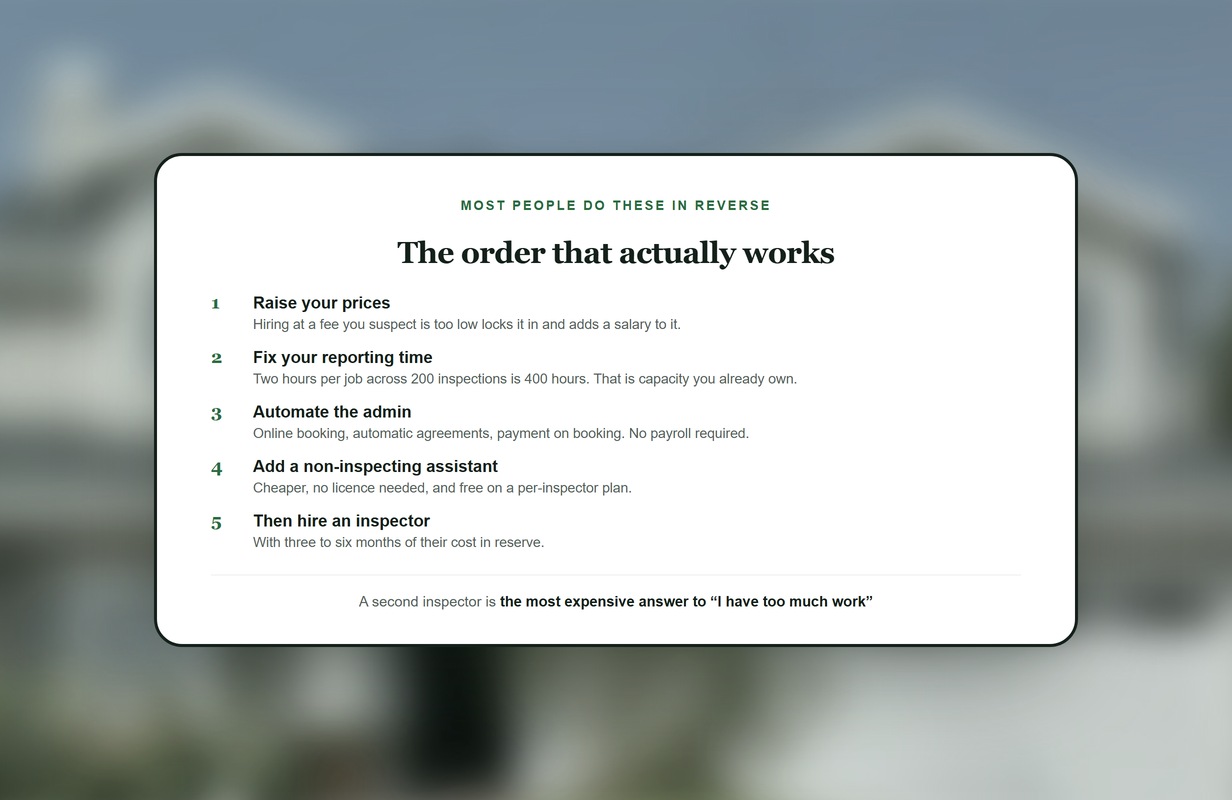
Raise your prices. Fix your reporting time. Automate the admin. Add a non-inspecting assistant if the load is administrative. Then, if you are still consistently turning away work at the higher price with an efficient workflow, hire an inspector.
Most people do these in reverse and wonder why the hire did not fix anything.
Frequently asked questions
Keep reading
More in how much a home inspector should charge, streamlining your inspection business and Binsr features.
Try Binsr on five real inspections. No time limit, no credit card. See pricing or start your trial.