How to Move Your Comment Library to New Software
Your comment library is the reason switching feels expensive. How to export it safely, what breaks in migration, and the four checks to run before you commit.

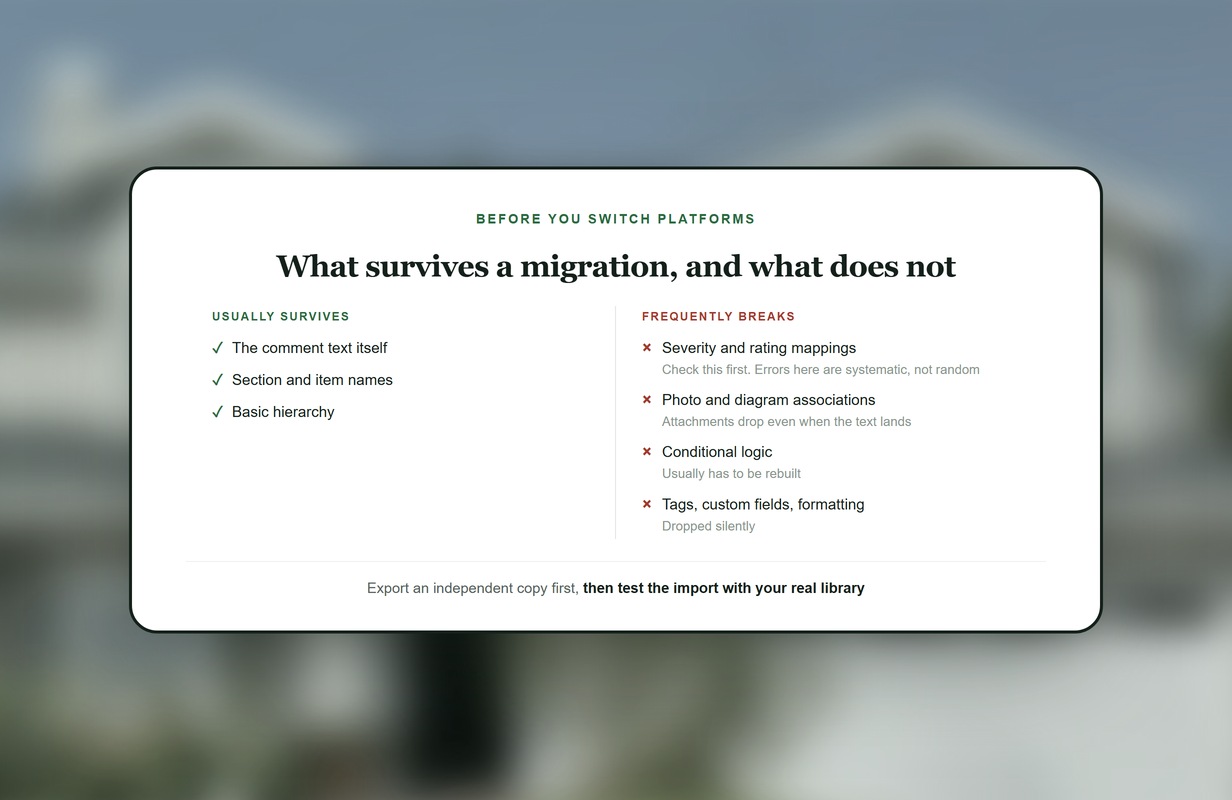
Short answer: Export an independent copy before you do anything else, then test the import with your real library during a trial rather than a sample template. What survives migration is usually the text; what breaks is structure, severity mappings, photo associations and anything conditional. Budget time to check those four specifically.
The comment library is why most inspectors stay on software they have stopped enjoying. It is years of wording that survived client questions, agent pushback and the occasional contractor dispute, and rebuilding it is a genuine cost measured in weekends.
It is also more portable than most vendors let on, if you approach it in the right order.
Export first, evaluate second
Before you demo anything, get an independent copy of your library out of your current platform and store it somewhere you control.
Do this even if you are not switching. Software gets acquired, retired and repriced. Horizon is retiring in December 2026 and its users are migrating whether they planned to or not. Spectora acquired HomeGauge. Nobody on either platform chose that.
Your language is the asset. The software around it is replaceable and, increasingly, replaced.
Most platforms offer some export. If yours does not, that is worth knowing now rather than during a migration, and it is a reasonable thing to ask support directly.
What usually survives, and what does not
Usually survives: the comment text itself, section and item names, basic hierarchy.
Frequently breaks:
Severity and rating mappings. Every platform models these differently. A four-level scheme does not map cleanly onto a three-level one, and the mismatch usually resolves in whatever direction the importer guessed. This is the one to check first, because a comment that arrives with the wrong severity is worse than one that did not arrive.
Photo and diagram associations. Comments with attached reference images often lose the attachment even when the text lands.
Conditional logic. Anything that shows or hides based on a previous answer. Most of this does not transfer and has to be rebuilt.
Tags and custom fields. Platform-specific concepts rarely have an equivalent, and are usually dropped silently.
Formatting. Bold, bullets and line breaks inside comments frequently arrive as plain text or with stray markup.
Test with your real library, not a sample
This is the single most useful thing you can do, and the thing most inspectors skip because it feels like commitment.
Vendors demo migration with a clean template. Your library is not clean. It has fifteen years of edits, duplicates, comments that reference a section you renamed, and at least one that still mentions a client's name from 2019.
Import the real thing during the trial. If a vendor cannot do that before you pay, you have learned something useful about how the migration will go afterwards.
Binsr's AI importer is built to bring templates and comment libraries across from other platforms while preserving your wording and structure, and the trial is five free inspections with no time limit, which is enough to import properly and run real jobs against it.
The four checks after import
Do these in order, on the imported library, before you run a real inspection with it.
1. Spot-check severity. Pick twenty comments across different severity levels and confirm each arrived at the right one. Errors here are systematic rather than random, so twenty samples will find the pattern if there is one.
2. Check your top twenty findings. The comments you use on almost every job: GFCI protection, grading, roof covering, handrails, water heater, dryer venting, aged HVAC. These carry most of your reporting volume, so they need to be right before anything else.
3. Look for truncation and stray markup. Long comments sometimes cut off. Formatting sometimes arrives as visible characters. Both are easy to fix and embarrassing to discover in a delivered report.
4. Test the whole path. Build one complete report from the imported library and deliver it to yourself as the client sees it. Digital and PDF. This catches things no spot-check will.
Treat it as an opportunity to prune
A migration is the one time you will look at every comment in your library, so use it.
Most libraries have accumulated far too many near-identical options per item. Forty comments at the kitchen sink means scrolling and reading to choose one, which is slower than typing. Around five primary options per item is the practical ceiling: enough to cover what you genuinely encounter, small enough that you know what is in it.
Delete duplicates. Delete the ones you have not used in two years. Fix the wording you have been meaning to fix. You will not get a better moment.
Do not migrate a bad library
If your library is genuinely poor, and some are, importing it moves the problem rather than solving it.
Starting from a professional library and editing it into your voice is faster than rebuilding, and produces better wording, because reacting to language is easier and more accurate than generating it. Binsr ships more than 12,000 comments and templates written by two inspectors with over 60 years of combined field experience, plus the KC Bartley Inspection Template and official state forms.
The honest test: if you were starting today, would you write these comments this way? If mostly no, import a good library instead and keep only the comments that are genuinely yours.
Questions to ask any vendor
Can I import my real library before I subscribe?
Who does the work, me or you?
What specifically does not transfer?
Can I export everything again later, and in what format?
What happens to my library if I cancel?
The answers vary far more than the marketing does, and the last two are the ones nobody asks.
Frequently asked questions
Keep reading
More in building a comment library, free inspection templates in Binsr and Binsr features.
Try Binsr on five real inspections. No time limit, no credit card. See pricing or start your trial.
Sources and verification
Vendor pricing and capability claims were taken from each vendor's own published pages and checked in August 2026.
- Spectora: www.spectora.com/pricing
- HomeGauge: www.homegauge.com/one/pricing