Do You Have to Tell Clients AI Helped Write Your Report?
Inspectors using AI tools are unsure whether disclosure is required. What the standards actually say, what is defensible, and how to word it if you do disclose.

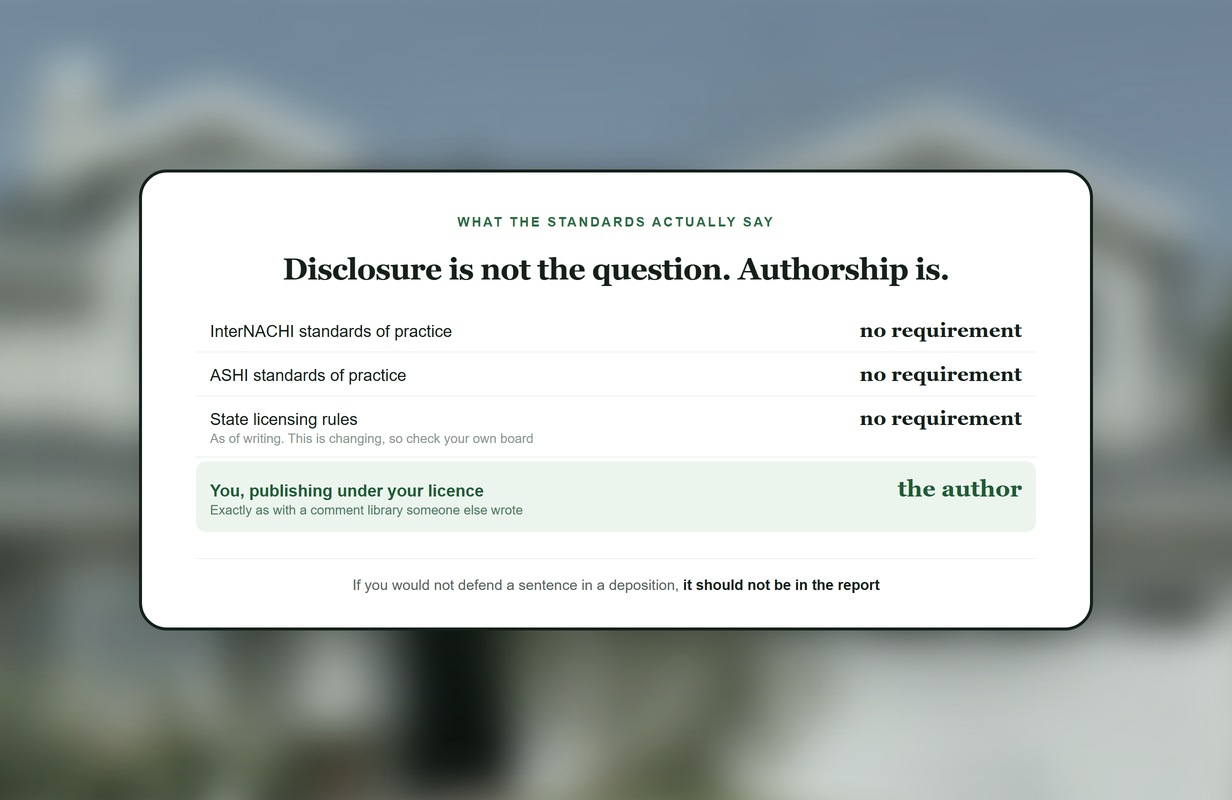
Short answer: No standard of practice currently requires you to disclose that AI assisted with your report, because AI is treated as a tool rather than an author. But the question that matters is not disclosure. It is authorship: you are the author and you carry the liability regardless of what drafted the sentence. If you would not defend a comment in a deposition, it should not be in the report, whoever wrote it.
This question comes up privately far more than publicly. Inspectors are using these tools, they are saving real time, and they are quietly unsure whether they are supposed to say so.
Nobody in the industry seems to have written it down. So here is the honest version.
This is not legal advice. Standards of practice and licensing rules vary by state and by association, and they are changing. Check your own state board and your E&O carrier before you rely on anything here.
What the standards actually say
Very little, and that is the point.
The major standards of practice, InterNACHI's and ASHI's among them, define what an inspection must cover, what may be excluded, and how findings should be reported. They are written around the inspection and the inspector's obligations, not around which software produced the document.
None of them contain a provision requiring disclosure of software assistance, and that is unsurprising. No standard requires you to disclose that you used a comment library, a template, spell check, or voice dictation. The report is your professional statement regardless of what helped you produce it.
State licensing rules follow the same pattern. They govern scope, competence, conduct and reporting content. As of this writing, there is no state requirement to label AI-assisted inspection report language.
That could change. AI disclosure rules are appearing in other regulated fields, and inspection is a licensed profession in most states. Worth watching rather than assuming.
Why disclosure is not the real question
The framing itself is slightly wrong, and it is why the question feels unresolved.
Disclosure implies AI is a co-author whose contribution needs acknowledging. It is not. It is a tool that produced a draft you then adopted. When you publish that report under your name and your license, you have authored every sentence in it, in exactly the way you authored the boilerplate comment you have reused four hundred times.
The right question is not "do I need to tell them?" It is "can I stand behind every sentence?" If the answer is yes, disclosure is beside the point. If the answer is no, disclosure does not save you, because a disclaimer does not transfer liability to a language model.
Where the actual risk sits
Not in the client's opinion of AI. In three specific failure modes.
Fluent, wrong content. These systems generate plausible text. Given thin input, they will fill gaps with things that sound right. A fabricated detail in an inspection report is a fabricated detail in a legal document, and "the software wrote it" is not a defence. This is the risk that matters most, and it scales with how little you gave the tool to work with.
Language you would not have chosen. AI-drafted comments drift toward the confident and the general. An inspector writing manually hedges instinctively in the right places, because they know where their observation ended. A generated comment may state as fact something you only inferred, or omit the limitation that protects you.
Consistency that hides an error. If you set standing instructions and one of them is subtly wrong, it will be subtly wrong across every report until you notice. Manual writing produces scattered errors. Automated writing produces systematic ones.
What actually protects you
Read every word before you publish. Every report, every time. This is still far faster than writing it yourself, which is the whole point, but it is not optional. Reading a generated report is the professional act; generating it is not.
Give the tool real input. The less context it has, the more it invents. Speaking a complete finding, with location, condition and recommendation, produces a comment grounded in your observation. A two-word note produces a paragraph the model largely made up.
This is the design principle behind Binsr's AI Voice Quick Add: capture the whole observation on site so the model is organizing what you said rather than filling gaps you left.
Never let it make the call. Whether something is a defect, how serious it is, whether it needs a specialist, whether it is a safety hazard. Those are your judgments, they are what your client is paying for, and they are what your licence covers. Use AI for the writing between your judgment and the client's understanding of it.
Watch the qualifiers. When you review, look specifically for statements more confident than your actual observation supports, and for missing limitations. That is where generated language tends to fail. Standing guidance helps here; Binsr's AI Instructions let you set how cautious your report language should be once, rather than correcting the same drift on every job.
Ask your E&O carrier. Some now ask about AI use at renewal. Better to raise it yourself than to have it come up after a claim.
If you do want to disclose
Some inspectors will want to, either because they think it is right or because they would rather be ahead of it. That is a defensible choice, and it costs nothing if the wording is correct.
The wording should make clear that the inspector is the author. Something to the effect of: the observations, judgments and recommendations in this report are the inspector's own; software tools, including AI-assisted drafting, were used to help prepare the written report.
What to avoid is anything that reads as shifting responsibility. A line implying the report is partly the software's work invites exactly the question you do not want asked, and it is not true anyway.
Keep it in the report's methodology or limitations section, not in the summary. It is a note about process, not a finding.
What clients actually think
Less than inspectors fear, and it cuts both ways.
Buyers are using AI daily. The idea that professional software includes it is not shocking to anyone. What they care about is whether the report is accurate, clear, and produced by a human who went into the crawlspace.
The concern, when it appears, is usually not "did a computer write this?" It is "did anyone actually look at my house?" That is a fair question, and the answer is in the specificity of your report. A report full of observations that could only come from that property answers it without a disclosure line. A report full of generic language raises it regardless of whether AI was involved.
The short version
You are the author. You carry the liability. No current standard requires disclosure, disclosure would not transfer responsibility if it did, and the thing that actually protects you is reading what the software wrote and refusing to publish anything you would not defend.
Use the tools. They save real hours. Just do not confuse a faster draft with a lower standard.
Frequently asked questions
Keep reading
More in the AI glossary for home inspectors, what changed in inspection software since 2025 and the Binsr report builder.
Try Binsr on five real inspections. No time limit, no credit card. See pricing or start your trial.
Sources and verification
The standards of practice referenced here were checked in September 2026. Neither requires disclosure of AI assistance.
- InterNACHI Standards of Practice: www.nachi.org/sop.htm
- ASHI Standard of Practice: www.homeinspector.org/Resources/Standard-of-Practice