How Accurate Is AI Photo Defect Detection?
AI photo analysis is useful as a second look and unreliable as the only look. What it catches, what it misses, and how to use it without creating liability.

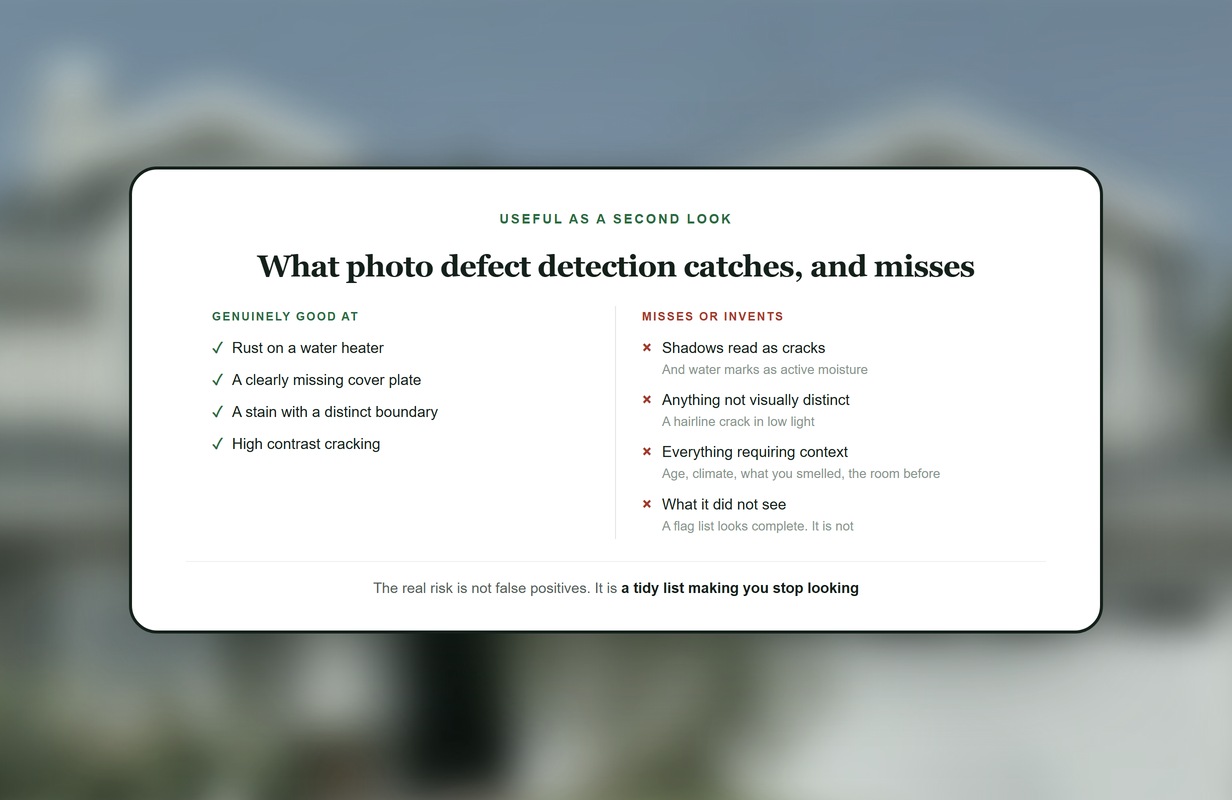
Short answer: Useful as a second pair of eyes, unreliable as the first. It flags things that are not defects and misses things that are, and neither failure is predictable enough to plan around. Treat it as a prompt for your attention and it earns its place. Treat it as a decision and it becomes a liability.
Every vendor selling photo defect detection describes what it catches. Almost nobody describes what it misses, which is the part that matters if you are going to rely on it.
What it actually does
The software examines an inspection photograph and flags visual patterns associated with defects: cracking, corrosion, staining, discolouration, missing components, obvious damage.
It is genuinely good at the visually obvious. Rust on a water heater, a clearly missing cover plate, a stain with a distinct boundary, a crack with high contrast against its surround. If your concern is failing to notice something plainly visible in a photograph you took at speed, it helps.
Several platforms ship it now, including Palmtech's Image Defect Detector, and AI is now standard across the category. It is no longer a differentiator; the question is how you use it.
Where it fails, and why the pattern matters
False positives, constantly. Shadows read as cracks. Water marks on concrete read as active moisture. Normal wear reads as damage. Paint texture reads as surface failure. You will spend real time dismissing things that are fine, and that time is a cost the marketing never mentions.
It misses what is not visually distinct. A hairline crack in low light. Something behind an obstruction. A condition that only reads as a problem because of what is next to it, or because of the age of the building. Anything where the defect is an absence rather than a presence.
It has no context. This is the deep limitation, and it is not a resolution problem that gets fixed with a better model. A photograph does not carry the age of the house, the climate, the construction type, what you smelled, whether the floor felt soft, or what you found two rooms earlier. An inspector integrates all of that continuously. A model sees pixels.
It cannot tell you what it did not see. A flag list looks complete. It is not. Nothing in the output distinguishes "no defects present" from "no defects visible in this frame", and those are very different statements to put in a report.
The failure mode that actually creates risk
Not the false positives. Those are annoying and visible.
The risk is the false sense of completeness. When software returns a tidy list of findings, it is psychologically hard to keep looking. The list feels like the answer. That is the moment where an inspector stops doing the thing the client is paying for, which is looking carefully at a building with an experienced eye and an intent to find problems.
This risk is worse for newer inspectors, who have less internal reference to notice that something is absent from the list. It is the reverse of how the tool is usually marketed, which is as a safety net for the less experienced.
How to use it without creating exposure
Photograph first, analyse second. Do your own assessment before you look at what the software flagged. If you look first, you are checking its work instead of doing yours, and you will anchor on its list.
Treat every flag as a question, not a finding. "Is this something?" not "this is something." Then confirm it yourself, and write the comment from your observation rather than from the flag.
Never publish a flag you did not verify. If the tool identified something and you did not personally confirm it, it does not belong in the report. You are the author of every sentence in it and you carry the liability regardless of what generated the draft.
Watch for the confidence gap. Generated language tends to be more certain than the underlying observation supports. "The flashing is improperly installed" where the honest version is "flashing appears improperly installed at the visible portion; remainder concealed."
Notice what it never flags. If it has not raised a category of finding in fifty inspections, that tells you where its blind spots are. Those are the places to look harder, not less.
Where the technology is genuinely more useful
Photo analysis on its own is a narrow tool. The more valuable applications sit either side of it.
Annotation. Marking up the image so the client sees the specific thing you are pointing at. Most confused-client phone calls come from a photograph that documented a defect without communicating it. Binsr handles this with AI Image Annotations, and it does more for report quality than detection does.
Organisation. Sorting sixty photographs into the right report sections is genuinely tedious and genuinely automatable, with no judgment involved and no liability if it is wrong, because you will see it.
Turning capture into content. The largest gain is not identifying the defect. It is that you photographed and described the finding on site, and the report content exists before you leave. Detection assumes you will assess the image later. Capture-first means you already did, at the property, with your own eyes.
The honest summary
Photo defect detection is a useful second check that will make you slightly less likely to overlook something obvious, and slightly more likely to waste time on shadows. That is a reasonable trade at no extra cost.
What it is not is a substitute for looking. The moment it becomes the first opinion rather than the second, it has stopped helping.
Frequently asked questions
Keep reading
More in the AI glossary for home inspectors, whether an AI-written report holds up in a dispute and Binsr features.
Try Binsr on five real inspections. No time limit, no credit card. See pricing or start your trial.
Sources and verification
Vendor capability claims were taken from the vendor's own published pages and checked in August 2026.
- Palmtech: www.palmtech.com/pricing