Will AI Replace Home Inspectors?
No, and the reasons are physical access and liability rather than sentiment. What AI genuinely changes about the job, and which parts of it are not automatable.

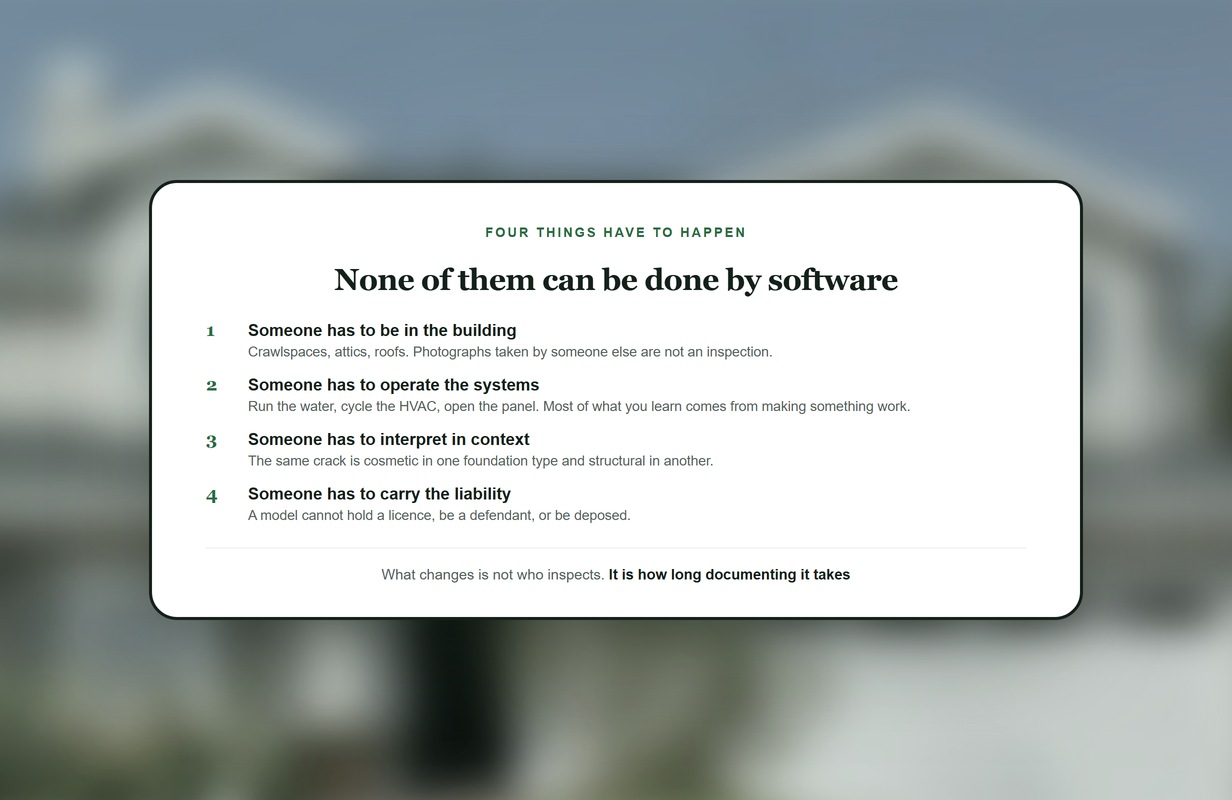
Short answer: No. An inspection requires someone to physically enter the crawlspace, operate the equipment, interpret what they find in the context of that property, and carry professional liability for the judgment. AI cannot do any of the four. What it does change is how long documenting that judgment takes, which is a real change but a different one.
The question gets asked in two very different tones. Homebuyers ask it wondering whether they still need to pay for an inspection. Inspectors ask it wondering whether they still have a career.
The answer is the same for both, and the reasoning is more concrete than the usual reassurance.
The four things that have to happen, and why software cannot do them
Someone has to be in the building. Crawlspaces, attics, roofs, mechanical rooms. A model has no access to any of it. Photographs taken by someone else are not an inspection, they are a record of what that person chose to photograph, which is a much narrower thing.
Someone has to operate the systems. Run the water, cycle the HVAC, test the receptacles, open the panel, check the drainage under load. Inspection is an active process, not an observational one. Most of what an inspector learns comes from making something work and watching how it behaves.
Someone has to interpret in context. A stain means different things in a 1920s house in a wet climate and a 2019 build in a dry one. The same crack is cosmetic in one foundation type and structural in another. This is pattern recognition trained on doing the job, not on reading about it, and it depends on facts about the specific property that nobody has written down.
Someone has to be liable. This is the one that ends the conversation. An inspection report is a professional opinion attached to a licence and an E&O policy. A model cannot hold a licence, cannot be a defendant, and cannot be deposed. If nobody carries the liability, nobody will accept the report, and lenders and attorneys will decide that long before inspectors do.
What AI genuinely does change
It removes the distance between the judgment and the client's understanding of it, which is most of what AI is actually doing in this category. That distance used to be measured in evenings.
The traditional shape of the job is inspect, take notes, go home, write. The writing is transcription of something you already knew hours earlier. Voice and photo capture can turn observations into report content while you are still at the property, which is why we built Binsr around capture during the inspection rather than after it.
The consequence is not a smaller profession. It is a different distribution of the working day: more time on site, less time typing.
The things that will change, honestly
Pretending nothing shifts is as unhelpful as predicting replacement.
Report writing stops being a differentiator. If competent, clear reports become easy to produce, being good at writing them no longer separates you. What separates you moves to what you find, how you explain it in person, and how easy you are to work with.
Turnaround expectations compress. When same-day delivery is normal, it stops being a selling point and starts being a baseline. That pressure is already visible and it is the change most inspectors will feel first.
Volume per inspector can rise. An inspector who recovers two hours per job can either do more inspections or work fewer hours. Both are real options, and the second is the one more people should take.
The low end gets squeezed. An inspector competing purely on price, producing a minimal report, is competing with something that got cheaper. An inspector competing on judgment and client experience is not.
What buyers should take from this
If you are buying a house and wondering whether AI has made inspections unnecessary: it has not, and the reason is not sentiment about human expertise.
An AI cannot go into the crawlspace. It cannot smell gas. It cannot run the shower and watch what happens two floors down. It cannot tell you it is uneasy about something that has not technically failed yet, which is frequently the most valuable thing an inspector says.
What you can reasonably expect is a better report, delivered faster, with photographs that actually show the problem. That is what the technology has changed.
The risk nobody markets
There is a real downside worth naming, and it is not job losses.
These systems produce fluent text that can be wrong. Given thin input, they invent plausible detail. In an inspection report, which is a legal document, a fabricated detail is a genuine problem, and "the software wrote it" is not a defence.
So the inspectors who do well with these tools will be the ones who read every word before publishing, and who never let the software decide what constitutes a defect. The failure mode is not being replaced by AI. It is trusting it too much and publishing something you cannot defend.
What to actually do about it
If you are an inspector, the useful response is not reassurance and not panic. It is measuring one number: the time from leaving the property to the client having the report.
If that number depends on an evening at a desk, the compressing turnaround expectation is a problem you have not felt yet. If most of the report exists before you close the front door, you are already positioned for where this is going.
Everything else follows from that. The tools are worth adopting because they buy back hours. The judgment stays where it is, because it has nowhere else to go.
Frequently asked questions
Keep reading
More in the AI glossary for home inspectors, whether an AI-written report holds up in a dispute and Binsr features.
Try Binsr on five real inspections. No time limit, no credit card. See pricing or start your trial.