What Home Inspectors Should Know About AI in 2026
Which AI tools are worth adopting, which claims to ignore, what it costs, and where the liability sits. A practical orientation for inspectors, not a pitch.

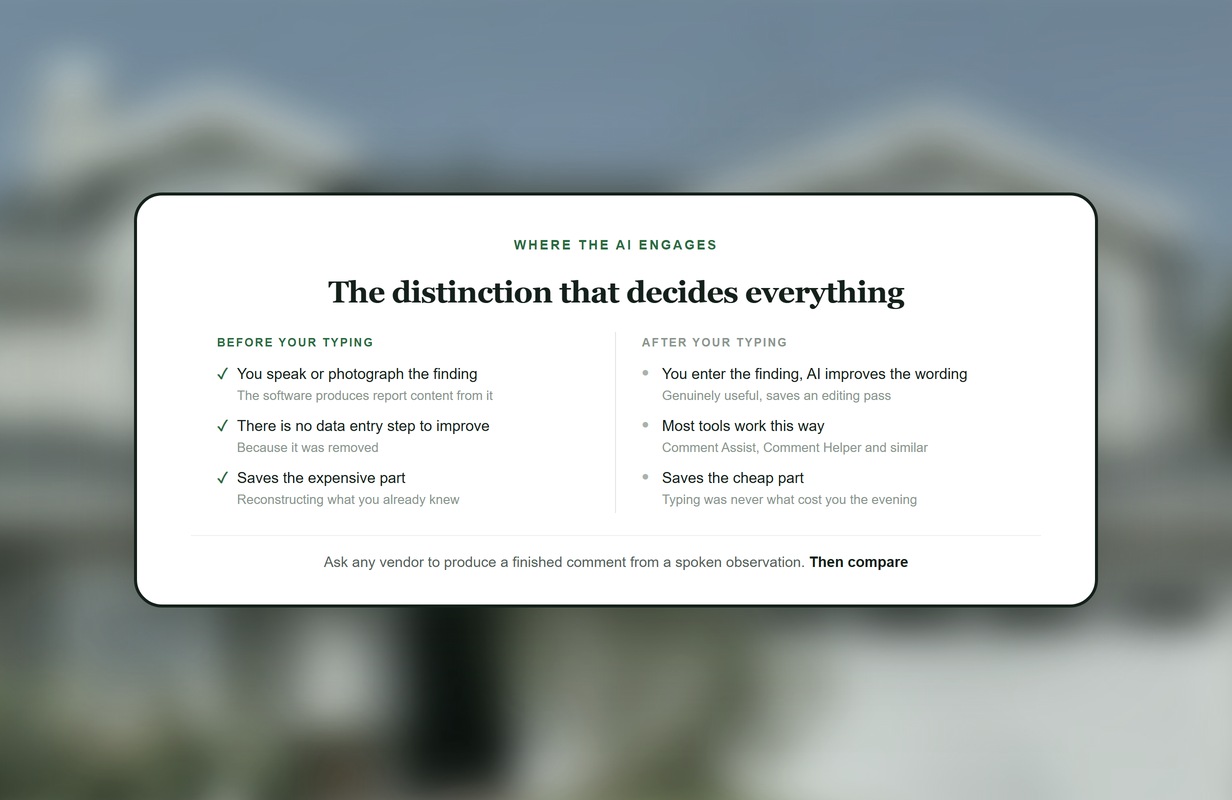
Short answer: AI is now standard in inspection software, so "has AI" tells you nothing. What matters is whether it engages before or after your data entry, because only the first kind removes work. The judgment stays with you, the liability stays with you, and the cost is coming to everyone's invoice eventually. Adopt the capture tools, read every word they produce, and ignore anything promising to find defects for you.
If you last thought about this properly a year ago, several things have changed. Here is the orientation, with the specifics.
AI is no longer a differentiator
Two years ago "has AI" was a reason to choose a platform. It is not now, and any comparison telling you a major vendor lacks it is out of date.
Spectora made AI Comment Assist free to every user in June 2026. Palmtech ships an AI Image Defect Detector and Comment Helper in Palmtech 11 at no extra charge. ISN has a Comment Helper. Most platforms have something.
The useful question has moved. It is no longer whether a vendor has AI, but where in your workflow it engages.
The distinction that actually matters
After you type. You enter a finding, the AI improves the wording. Genuinely useful, saves an editing pass. Most tools work this way.
Before you type. You speak or photograph the finding and the software produces report content from it. There is no data entry step to improve, because the data entry step is what got removed.
The second is a larger saving, because typing was never the expensive part of your evening. Reconstructing what you already knew four hours ago is. A note saying "GFCI kitchen" costs you two minutes tonight; speaking the complete finding on site costs you nothing afterwards.
Binsr is built around the second approach, with AI Voice and Photo Quick Add, Image Annotations, Galleries, AI Instructions and Combine Comments with AI. When you evaluate any platform, ask to see it produce a finished comment from a spoken observation. If what comes back is a transcript you still have to shape, that is voice-to-text, which is a different and much older thing.
What is worth adopting
Voice capture that produces report content. The largest single gain available. Speak the complete thought, including location, condition and recommendation.
Photo annotation. Marking up the image so the client sees the specific defect rather than a wall. Most confused-client phone calls trace back to a photograph that documented a finding without communicating it. This does more for report quality than defect detection does.
Automatic organisation. Sorting sixty photographs into report sections. No judgment involved, no liability if it is wrong, and genuinely tedious to do by hand.
Standing instructions. Setting once how cautious your language should be, rather than making the same edit on every report. Manual writing produces scattered inconsistency; standing guidance removes it.
Administrative automation. Invoice on publish, notify the agent, follow up on non-payment. Unglamorous, and it removes more of your week than most of the features with better marketing.
What to be sceptical about
Defect detection as a primary tool. Useful as a second look, unreliable as the first. It flags shadows and normal wear, and misses anything not visually distinct or requiring context a photograph cannot carry. The real risk is not the false positives, which are visible. It is the false sense of completeness: a tidy list of flags makes it psychologically harder to keep looking.
Anything implying the software finds problems for you. It does not. It processes what you gave it.
Claims about time saved. Including the ones vendors make about themselves. Measure your own door-to-delivery time before and after, over five inspections each way. That number is the only one that matters and it is yours to collect.
Where the liability sits
Unchanged, and this is the part inspectors most want clarity on.
You are the author of every sentence in your report. Publishing it under your name and licence means you adopted it, exactly as you adopted a comment library someone else wrote. "The software wrote it" is not a defence, and a disclaimer does not transfer responsibility to a model.
No current standard of practice or state licensing rule requires you to disclose AI assistance. That could change, and it is worth watching, but disclosure was never the real question. Authorship is.
The three failure modes worth guarding against: fabricated specificity where the tool had too little input and filled the gap; overconfident language stating as fact something you only inferred; and systematic error, where one wrong standing instruction replicates across every report until someone notices.
All three are caught by reading every word before publishing. That is faster than writing it yourself, which is the whole benefit, but it is not optional.
The cost nobody is discussing
AI has a real per-use cost to the vendor, and it scales with how much you use it.
Most platforms have not priced that in. They added AI to an existing subscription without changing the subscription. That is pleasant now and unlikely to hold, because the economics do not work at volume. A low headline price with AI bundled in is a bill deferred rather than a bill avoided.
Binsr prices it openly instead: $4 per completed inspection on the Pro tier, visible on the invoice from day one. Whichever approach you prefer, ask any vendor directly what happens to their pricing as AI usage grows. A vendor who has already answered that is one whose costs you can plan around.
One genuine advantage nobody markets
Capturing findings on site produces a contemporaneous record as a by-product: timestamped, annotated photographs and voice notes taken at the property, before any software touched them.
If a finding is ever challenged, that record is stronger evidence than the report itself, because it shows what you observed at the time rather than what you reconstructed at 9pm. Inspectors who write from memory in the evening do not have it.
The speed is the visible benefit. This is the one you only appreciate on the day someone questions a comment.
What to actually do
Measure your door-to-delivery time. Minutes from leaving the property to the client having the report, across five inspections. If that number depends on an evening at a desk, the compressing turnaround expectation is a problem you have not felt yet.
Trial capture-first on real jobs. Not a demo property. Import your own comment library, run real inspections, and see how much of the report exists when you close the front door.
Build the review habit before you need it. Read every generated word. Look specifically for statements more confident than your observation supports, and for missing limitations.
Do not delegate the judgment. What constitutes a defect, how serious it is, whether it needs a specialist. That is what your client is paying for and what your licence covers.
Frequently asked questions
Keep reading
The rest of this cluster: will AI replace home inspectors, do you have to disclose AI use, how accurate is AI defect detection and does an AI-written report hold up in a dispute.
Try Binsr on five real inspections. No time limit, no credit card. See pricing or start your trial.
Sources and verification
Every vendor capability named here was taken from that vendor's own published pages and checked in August 2026.
- Spectora: www.spectora.com/pricing
- Palmtech: www.palmtech.com/pricing
- ISN: www.inspectionsupport.com/pricing