How to Price Radon, Mold and Sewer Scope Add-Ons
Ancillary services need their own arithmetic, not a discount off the main inspection. How to tell whether radon, mold or sewer actually pays for itself.

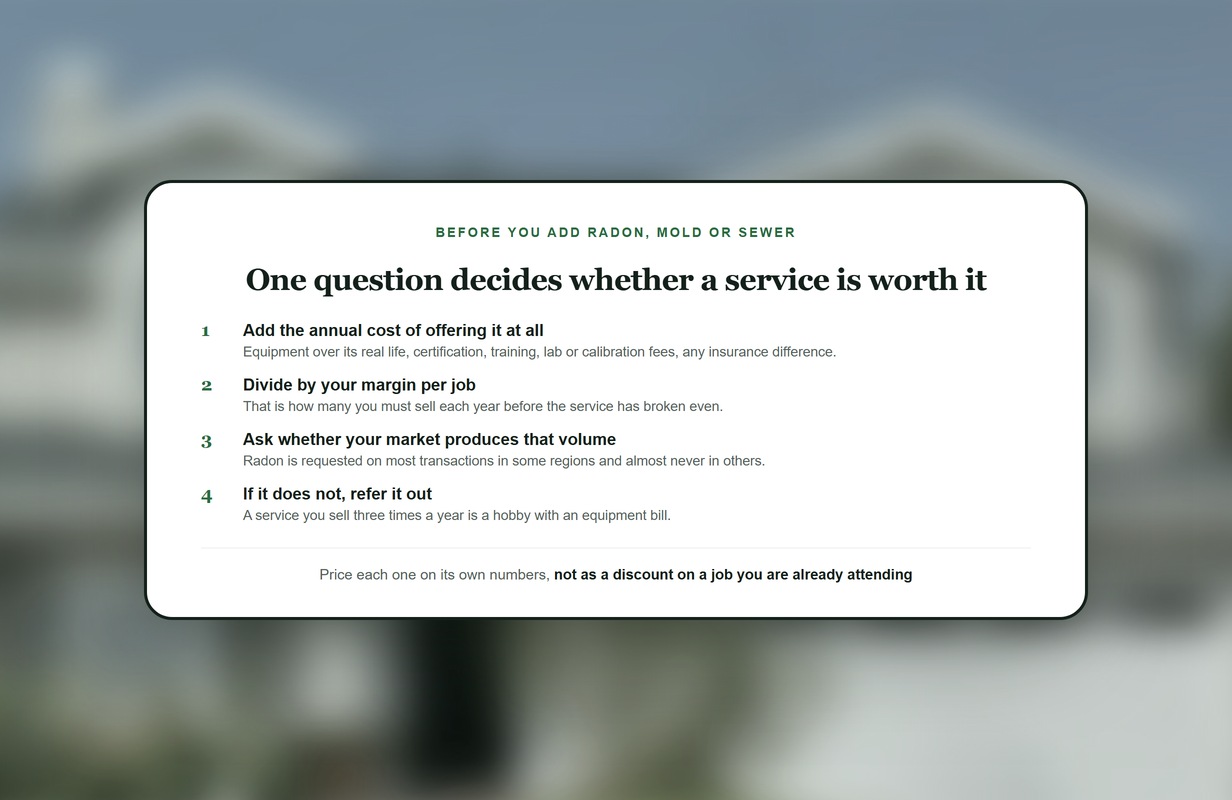
Short answer: Price each service on its own equipment, training, time and liability, then work out how many you must sell annually for it to pay for itself. If that number is not realistic in your market, the service is a hobby. The common mistake is treating add-ons as discounted extras on a job you are already attending, which quietly makes them your least profitable work.
Ancillary services are the standard advice for growing inspection revenue, and the advice is usually right. It is also usually given without the arithmetic that decides whether any particular service is worth adding.
Why "I am already there" is the wrong starting point
The reasoning is seductive. You are at the property anyway, the marginal time is small, so a modest add-on fee is nearly pure profit.
It is wrong in three ways.
The equipment is not free. A radon monitor, a sewer camera, a thermal camera, a moisture meter of adequate quality. These are capital purchases that need replacing, and they only earn out across volume.
The training is not free. Certification, continuing education, and the time to become genuinely competent. An inspector who is mediocre at a service is worse than one who does not offer it, because now the finding is unreliable and it is in your report.
The liability is not free. Each service extends your exposure into a new area, often one with its own standards and its own failure modes. Check with your E&O carrier before adding one; some require notification and some price it.
Once those are counted, the marginal-time argument stops being the whole story.
The number that decides it
For each service, work out the annual cost of offering it at all: equipment amortised over its realistic life, certification and training, any recurring lab or calibration costs, insurance difference, and the software or reporting overhead.
Then divide by the margin per job. That is how many you must sell each year before the service has broken even.
Now ask honestly whether your market produces that volume. In some regions radon testing is requested on most transactions. In others it is rare enough that the monitor sits in a cupboard. Sewer scopes make obvious sense in areas with older clay laterals and mature trees, and much less in newer developments.
If the required volume is not realistic, do not offer the service. Refer it out, keep the relationship, and stay good at what you do.
Price on time and risk, not on convenience
Once a service passes the volume test, price it as its own product.
Time. Actual door-to-door time including setup, retrieval where applicable, analysis and the additional reporting. Radon in particular has a hidden cost: it usually needs a second visit, and a second visit is a second drive.
Consumables and lab fees. Pass them through visibly rather than absorbing them.
Risk. Some services carry more exposure than others. Anything where a wrong result has health or structural consequences deserves a fee that reflects that, not a fee that reflects how long it took.
Equipment recovery. Build a portion of replacement cost into every job so the next camera is funded by the last hundred inspections rather than a bad month.
The bundling trap
Bundle discounts are the most common way inspectors make ancillary work unprofitable.
The logic is that a discounted package moves a client from one service to three, so total revenue rises. That is only good business if each service is individually profitable at the discounted rate. If the bundle price drops radon below its own break-even, you have just sold more of your least profitable work.
If you bundle, discount the smallest component rather than all of them proportionally, and never discount the service with the highest liability.
There is a better version of the same instinct: sell the combination on value rather than price. An inspector who does the septic and the house can connect findings across both, which a client cannot get from two separate vendors. That is worth full price, not a discount.
Where ancillary services genuinely pay
Not primarily in the fee. In three second-order effects.
They raise the ceiling on your main inspection price. An inspector who can competently assess more of the property is delivering a different service from one who cannot, and that supports a higher base fee, not just an add-on line.
They reduce referral leakage. Every service you refer out is a moment where someone else talks to your client.
They compound your judgment. Doing sewer scopes for two years makes you better at reading drainage symptoms during a standard inspection. That is real, and it is invisible on the invoice.
Practical sequencing
Add one service at a time and let it mature before adding another. Inspectors who add three at once end up mediocre at all of them and unable to tell which is actually earning.
Start with whichever your market asks for most, since demand you already turn away is the lowest-risk place to begin. Track it separately in your reporting for the first year: jobs sold, revenue, time spent, so you can see the real margin rather than assuming it.
If your business dashboards let you segment by service type, use that. In Binsr that sits in the business reporting, and the point is simply to know which services earn rather than which feel busy.
Do the same arithmetic on your base fee
Ancillary pricing gets attention because it feels like a growth lever. Frequently the larger opportunity is the main inspection.
If your base fee has not moved in two years while insurance, fuel and equipment costs have, adding a $150 radon test is compensating for a shortfall you could fix directly. Work out the base fee your costs and capacity actually require first. Add-ons should be growth, not a patch.
Frequently asked questions
Keep reading
More in how much a home inspector should charge, raising your prices and Binsr pricing.
Try Binsr on five real inspections. No time limit, no credit card. See pricing or start your trial.